Da, da-da, da: Done!
And just like that, my adventure in law school has come to an end. I completed my final final and, as far as I know, do not have a single further obligation for law school. Ok, I have to be in court tomorrow for a client, and that's technically law school-related, but only in the most technical sense. I also have law school loans to repay for, oh, maybe the rest of my life, but how about we not think about that right now, hmm? Good, thanks.
The feeling is definitely one of anticlimax. So this is it? This is what it feels like? It doesn't help that I've felt pretty done for a week or more now, really. Or maybe I've really been done since about the first week of last December when I finished my last real final. I dunno. What I do know is that now there is no excuse for not doing the other things that I must do: clean up the apartment so the landlord can show it to prospective renters (anyone want a good place to live in an excellent DC location for a relatively decent price?), arrange a moving truck, find a new place to live, mail off the application for the job of my dreams. You know, little things like that. Maybe I should get to work on all of that, you think?
But first, congratulations to Divine Angst who finished 1L today, and once again to Half-Cocked, who decloaked yesterday to announce that he is also finished with law school. I'm sure there are others who have finished (either with the school year or the whole shebang) or are going to finish soon, so best wishes to you all—may that moment of accomplishment be everything you've always hoped for!
Posted 04:24 PM | Comments (18) | TrackBack
Hey basket, meet all of my eggs!
Although I've tried to keep my whining to a minimum here, for the past six months or so, L. and I have been thinking of little else besides where we're going to be living six months from now. Yesterday, that dilemma was finally solved when she took a great job in Billings, Montana! And we're moving at the end of the month!
In a way it feels like I just took Jay-Z's choice b: “bounce on the devil put the pedal to the floor.” Suddenly things seem to be moving very quickly and there's no doubt that this is a huge gamble. Most sane law graduates get a job and then move; I'm going to be doing it the other way around. It feels crazy, and it probably is, but hey, what's life w/out a little risk? Or a lot?
Yikes.
Of course, first I have to successfully complete law school and suddenly even that seems like a gamble. My final final is tomorrow and I still don't have a clue what I'll be expected to summon from my brain (or my notes, such as they are. I better get crackin'!
Oh, a note to all of our friends and loved ones who have been so supportive during our uncertainty and who had high hopes we'd be moving to the Midwest: We will miss you and hope you will come visit us often in the Big Sky Country! Take the train from Chicago and we'll meet you in West Glacier! We'll certainly try to visit you as often as we can and will most likely be moving east again sometime in the future.
Posted 11:05 AM | Comments (20) | TrackBack
More LRAP: GW needs a real endowment
Once I get started, I just can't stop. But I'm thinking more about GW's LRAP. In a way you could say I came to GW only b/c of its LRAP b/c I only applied to schools w/LRAPs. That means if GW hadn't had an LRAP, it wouldn't have been on my list and everything would have been different. So I have always planned to get a job that qualifies for the LRAP and I hope to be able to take great satisfaction in the fact that GW will end up paying back some (I hope large) portion of my loans.
I've known from the beginning that as far as LRAPs go, GW's is no great shakes—barely funded, very restrictive in what jobs qualify, etc. But its great advantage is that almost no one uses it. GW grads almost never go into public interest law (the average is 1% of each class) so they almost never qualify for the LRAP. That means that even though it's barely funded, odds aren't bad that those few that do qualify will get money. Last year GW funded everyone who qualified for the LRAP at 100% of what they qualified for. I believe that is true for several previous years, as well. So that's great. The only problem is that available funding changes every year. The LRAP has an “endowment” of only $15,000, meaning there are virtually zero dollars dedicated to the program. Instead, most of the LRAP money comes from alumni donors and, recently, class gifts.
One hundred percent of last year's generous class gift went to the LRAP and they were able to fund everyone who qualified. This year, we have to split our class gift between LRAP and incoming student scholarships. One reason for that is that our new Dean has publicly expressed disdain for the LRAP several times; it's not a priority for him. I don't know how much say he has over where class gift money goes, but I know his antipathy toward the LRAP cannot be a good thing for its long-term health. With so little institutional support, is there going to be any money for people like me next year? The year after that?
Yet, solving this problem would be so simple. If 100% of class gifts for the next 5 years went toward the LRAP endowment (not to payouts, but to the principle), then in 5 years the endowment would go from $15,000 to $500,000. The interest alone on that endowment would probably be enough to fund most if not all of LRAP requirements. In fact, that's what should have been done before the school ever started claiming to have an LRAP. If it would be so easy, why not do it now?
Posted 03:00 PM | Comments (8) | TrackBack
GW Law Class of '06 Throws Down
 I just learned that my fellow graduating (we hope) students at GW have been very generous this year in giving to the class gift. As the chart at right shows, 61% of the graduating class have donated money, with some sections (including 14, of which I am a member) reaching nearly 70% participation. If you're not impressed, just compare that with last year's participation of 51% and you'll realize that the class of 2006 has done a great thing here. Once we passed 52% participation, a group of generous alumni agreed to match all donations 4-1, so the more than $19,000 we've given is going to become over $95,000! Thanks to everyone in my class for their generosity! I take back all those bad things I ever said or thought about you. Well, most of them, anyway. Ok, some of them. Oh nevermind! Just thanks, ok!?
All this class gift money goes either to the LRAP or to incoming student scholarships for “deserving” students—each donor was supposed to designate his/her gift for one pot or the other.
<rant>
I've tried to tell everyone who would listen that the LRAP is a much more worthy cause simply b/c LRAP money goes to people people who have made a commitment to use their legal education helping needy and underserved populations. If you give scholarships to incoming students, odds are 99% at GW that those people are not going to practice public interest law. The counter argument is that if you give money on the front end people don't have to take out loans so the total cost of law school becomes much less b/c there's no loan interest involved. Therefore, the school's money goes further w/scholarships. In other words, if you give $100 to an incoming student, you'll pay for $100 of law school expenses. If you give $100 in LRAP you'll pay around $95 of law school expenses and $5 interest (at an interest rate of 5% ).
My point is: Who does the money ultimately benefit? If you give to an incoming student, odds are 99% that money will benefit corporations and other private clients who can afford to pay top dollar for legal services b/c odds are 99% that an incoming GW law student will end up going to private, non-public-interest law. If you give via the LRAP to an outgoing student who is already working in public interest law, odds are 100% that money will benefit needy and underserved people who may not have otherwise been able to afford legal services. So yeah, a small portion of LRAP money goes toward paying interest to banks, but the lion's share goes toward increasing access to legal services in this country. Therefore, LRAPs are much more worthwhile (at least at a school like GW) than incoming student scholarships.
<rant/>
Are you convinced?
Posted 01:23 PM | Comments (37) | TrackBack
It's now official: Montana is hiring!
As of just a few minutes ago, the Montana State Public Defender began advertising for multiple open positions in its new offices around the state.
Positions are available in Kalispell, Polson, Missoula, Hamilton, Great Falls, Helena, Butte, Anaconda, Havre, Bozeman, Billings, and Miles City. Open until filled encourage interested applicants to apply by May 12, 2006. Applications will be considered for employment opportunities over the next 180 calendar days.

The two best parts for me are that they're advertising a starting salary of $43,999(!!) and this:
(emphasis added) So hey, I'm an ideal candidate! Hooray! Keep those fingers crossed!
Posted 05:29 PM | Comments (21) | TrackBack
Still in the running towards becoming*
Following a recent job interview comes this letter in the mail:
Thank you for participating in the first step of our interviewing process. We are happy to inform you that you have been recommended for a second interview. Due to our lengthy hiring process, we may not be contacting you for several months (or longer) with regard to scheduling this interview. Thank you in advance for your patience . . . .
So... Great? I guess... They sure know how to make a guy feel special!
* Props to anyone who can tell me the origin of “still in the running towards becoming.” Double props to anyone who uses it as the name for their blog.
Posted 01:04 PM | Comments (20) | TrackBack
What's “must-see” in the mid-Atlantic region?
Hey traveling people, I need your help: What places and things should I visit in the next 5 weeks before I leave this part of the country for good?
See, it looks like we'll be moving at the end of May—where has yet to be decided. Yeah, we decided when to move before we decided where. Sound crazy? That's just how we roll.
But wherever we end up moving, it's going to be pretty far from the D.C. area, which means there's no time like the present to make sure we've done and seen as much of that area as possible. So I ask you: What mid-Atlantic places would you put on your “must-see” list? Things I know I still want to do before I go include:
- Arlington Cemetery and the Iwo Jima Memorial
- Baltmore—harbor, aquarium, and what else?
- Colonial Williamsburg, VA
- Some beach in Delaware or Maryland maybe (I haven't been to the Atlantic coast once since we moved here!)
- ??
I'm obviously thinking of things that aren't too far from D.C. -- daytrips, a few hours of driving at most, probably. I was thinking about heading down to the lighthouses in NC but they are 300-400 miles away, which is definitely pushing it. Still, if there are must-see places at such distances from D.C., please let me know about them. We might be able to fit in a short multi-day roadtrip somewhere in there. And if not, at least we'll have a list of things to do some other time when we make it back this way. Thanks!
Posted 08:22 AM | Comments (26) | TrackBack
Another opening in Billings?
It seems the chief public defender in Billings, Montana, has decided to resign as of June 30, 2006. It seems like this can only be a good thing for me, considering that this resignation means there's one less lawyer who will be competing for a position in the PD's office in Billings and that's exactly where I hope to work.
The comments on the article about this are quite interesting. The first, from someone calling him/herself “Former Public Defender,” says that the woman who is resigning, Penny Strong, did not resign but was “forced out.” Someone called “Current Public Defender” responds with high praise for Strong, and a short exchange follows, with “Current” defending public defenders and arguing that it's no surprise that judges and prosecutors didn't like Strong, while variously-named interlocutors (who may all be “Former”) complain about Strong and public defenders generally. Based on this, it sounds like the Billings public defender's office has a lot of work to do in educating the public about its role in the criminal justice system. It also sounds like there's some controversy (possibly fringe) about the Yellowstone County Attorney; exactly what that's all about is unclear.
At any rate, it's all fascinating information for me, so thanks to the kind readers who sent me the link! As I mentioned previously, the Montana Public Defender Commission met this week to decide pay rates and hiring . . . at least I was told that's what they were going to talk about; the agendas are too vague for me to learn much from. Anyway, things are moving a bit in positive directions so my fingers remain crossed.
Oh, I also noticed that the Commission has put its Proposed Public Defender Standards online. I'll be taking a closer look at these soon...
It really is exciting to watch this new public defender system taking shape! And remember, “if it can happen in Montana, it can happen anywhere.”
Posted 12:22 PM | Comments (174) | TrackBack
Baffled w/BS
Because I know you care: I just turned in what may be my last academic papers—ever. That's a good thing.
One more final (in two freaking weeks!) and this law school thing will be all over but the shouting. And the debt. Yeah.
Posted 04:04 PM | Comments (1) | TrackBack
Best public interest law school plan ever!
The latest comment on Blonde Justice's great second thread about choosing a public interest law school concludes:
This is really the best plan I've ever seen for those who have some certainty they want to do a particular kind of public interest law when they graduate. Oh how I wish I had done this!
Posted 09:24 AM | Comments (2) | TrackBack
Feeling a little Lenina Huxley today...
I'm working on my last papers for law school (maybe ever), but it's kind of like all coming out wrong. Like, you know:
*sigh*
Posted 01:19 PM | Comments (1) | TrackBack
What is Public Interest legal work?
Every year the GW Equal Justice Foundation (EJF) gives out around 10 grants to students who are doing “public interest” legal jobs for no pay during the coming summer. And every year the GW EJF struggles to answer the question: What is public interest? The question comes up because you have to have a “public interest” legal job in order to receive a grant.
The language we've used the past two years to “define” such legal jobs reads:
The employer must be a non-profit 501(c)(3) or 501(c)(4) organization or a government agency. • Preference will be given to employers directly representing indigent, historically oppressed, or underrepresented people. • Employers advocating on behalf of indigent, historically oppressed, or underrepresented communities will also be considered. Indigent, historically oppressed, and underrepresented people and communities includes, but is not limited to, low income people and communities, victims of crimes, minorities, and gays, lesbians, bisexuals, and transgendered persons.
So the shorthand for that is if you work directly with needy clients, that almost definitely qualifies as a public interest job. If you advocate on behalf of needy people (e.g. in a more policy-oriented capacity, such as a human rights NGO), then you may qualify, but only if we have sufficient funds.
That all may sound clear enough as far as it goes, but the hard part comes when we have to look at specific legal jobs. For example, which of the following positions would you classify as a public interest job?
- Public Defender intern.
- Legal Aid Intern.
- Human rights NGO internship or similar (working for an organization which may write amicus briefs for litigation, but otherwise only “serves” or “works with” clients in a very broad sense.
- Prosecution intern.
- Judicial Clerk.
- Political intern (e.g. for a member of congress or local government official. These positions often are presented to the EJF tied to a specific project. For example, the student and employer both say “Student X will be researching and drafting model legislation to ensure that all children 18 and under will have full-service health care in our city.”)
I'm sure there are other options, but these are some broad categories that we have to deal with. My own initial preference has always been to fund the first three (in that order), and not the last three. However, many feel very strongly that jobs in the first four categories are clearly “public interest” legal jobs.
What do you think? Which of the above jobs is a public interest legal job and if you had to define such a job, how would you do it?
Posted 12:13 PM | Comments (2) | TrackBack
Advice for careers in criminal law
Professor Kerr recently asked for opinions on good advice for law students who might be considering careers in criminal law.
Coming from a law professor that is priceless! The post generated a veritable goldmine of priceless advice. First, these helpful thoughts on pursuing criminal appeals work, and more generally:
Excellent advice, I'm sure, but not so helpful if you made the mistake of taking internships in geographical areas where you can't/don't want to work. For people in that position (like me), a public defender offered this encouraging advice:
I've probably heard all of that before but it's great to see it all put together like that. In my recent interview one of the questions was: “Why did you spend a whole year working for this civil law thing? And don't they sue attorneys?” I couldn't figure out whether that seemed of interest to them b/c they thought it showed I'm not committed to criminal defense, or if they were concerned about it b/c they thought maybe I don't like lawyers and have some agenda to get them in trouble for malpractice. Now I realize it was probably both and if it comes up again I'll try to be more clear about addressing those potential concerns. (The real reason I did the civil law job was that it was interesting, it paid, and I wanted to learn at least about about the civil side of things while I had the chance.)
Many of the comments on this OrinKerr.com thread are from people doing criminal defense in private practice (like this one) and it's encouraging to hear that so many find that so rewarding since I might end up having to go that route if the public defender options don't come through.
The thread also offers a brief outline of how to start your own criminal defense practice, and this from a public defender that encapsulates why I prefer to find a job in a smaller jurisdiction:
Amen! I could quote just about every one of the comments here b/c they are all so helpful (this one even gives ), but better still, just read the rest of the thread on OrinKerr.com. If you're pursuing a career in criminal law, you'll find this 10 very well-spent minutes.
Law Schools for the Public Interest Student
Professor Appleman has a great post on Prawfsblawg about how law schools might better help law students find public interest jobs. She concludes with the following great suggestions:
The public interest students at GW have had some of the same thoughts Prof. Appleman expresses and we recently lobbied to get a full-time career person dedicated to public interest law. We were half successful; the dean has authorized a part time position and said that whoever takes the job can work as much as he/she needs to in order to get the job done. Apparently the dean does not believe there is enough demand for a full-time person, but we hope to prove him wrong. What we've found is that the demand might be appear strong if you survey incoming 1Ls about their career aspirations, but that demand drops precipitously as loan debt skyrockets, making students feel they are not able to consider a public interest career by the time they reach their 2nd and 3rd years. As I and others have said before, “I can't afford to take a public interest job” is often a fairly hollow excuse, but the fact remains that it's an excuse that almost certainly decreases the demand many law schools feel for public interest career services.
Posted 02:55 PM | Comments (2) | TrackBack
No more classes no more books, no more teachers' dirty looks!
I have attended my last law school class ever. That is extremely satisfying. Someday I suspect I'll look back on law school w/more fondness. That day may even be quite soon—as soon as my first loan payment is due, for example. But for now, no more class is a very good thing.
I still have a final clinic meeting tonight, a sentencing for a clinic client, and even a trial scheduled, but none of that is class (and it's hardly law school). I also have some short (5-page) papers to write and one final. So the fat lady has not sung, but she's definitely done with the voice lessons and just about ready to take the stage.
Posted 12:15 PM | Comments (7) | TrackBack
“It's injustice I hate, not the Normans.”
Congratulations to the GW Equal Justice Foundation and particularly this year's Auction Board for making the 2006 Public Interest Auction a huge success! The auction was held last Thursday and good times were had by all. In addition, the event once again raised over $30k (still waiting for a final total) for summer grants that will go to GW students who work for no pay this summer providing legal services to people in underserved communities. This was the third auction for me; in each one I played a progressively smaller role and each one seemed to go better than the last. I'll try not to read too much into that. ;-)
Friday I flew to Chicago for an interview. It went fine, but I was exhausted after Thursday's auction. Considering this was my first interview for a “real,” career-track legal job, you might think I would be more excited about it. It was exciting, I was happy to have the interview, I think it went well and I have high hopes that I'll get a second interview. That's all for now. Perhaps I'll have more to say on it soon.
Meanwhile, congratulations to Energy Spatula on the interview she landed for tomorrow. I hope it turns out to be everything she hopes!
Posted 07:46 AM | Comments (5) | TrackBack
Criminal Defense Dilemmas
Blonde Justice has had a string of absolutely fantastic posts recently about criminal defense dilemmas. The first jumps off from the witness tampering imbroglio at the Moussaoui trial and asks whether “my supervisor told me to do it” can excuse an ethical breach by an attorney. In the comments, that led to some great discussion, including consideration of the ineffectiveness of relying on lawyers to regulate each other's ethical conduct.
The second post raises an ethical dilemma about the duty of attorney A to tell attorney B about a questionable aspect of a case when A hands off the case to B. The excellent discussion in the comments includes this gem from “jasonpw”:
And this from PD Dude:
And finally this from That Lawyer Dude:
It never fails to amaze me how many people sit convicted of crimes because a lawyer refused to believe the story the client told them and wouldn't put it before the jury.
Blondie's third post in this great series about ethical dilemmas is mostly her reaction to the previous discussions, plus a little twist for further consideration. It also addresses the “interview by suggestion technique,” which an attorney can use to guide a client toward a story that fits well with what the attorney thinks is a good theory of defense in the case. For example, if you're accused of possession of cocaine, in order to be convicted you have to actually know the cocaine was in your bag/pocket/car/whatever, and you had to actually know it was cocaine and not powdered sugar or something else. So in the “interview by suggestion” technique, a lawyer might ask you: “So you had no idea what was in that bag, did you?” or “You saw the baggie, but you thought it was powdered sugar, right? I mean, Joey is a baker, isn't he?” (I apologize for the really bad examples, but I hope you get the idea.) Blondie says this technique isn't her style; it's not mine either. I've learned different things from different lawyers about the extent to which this technique is useful, but in my admittedly limited experience it just has never seemed very helpful.
One of my mentors once told me along these lines that instead of asking a client “what happened?” you should ask “what is the government going to say happened?” Of course, your client can't know this, exactly, but it gives the client an initial clue that what's important is not necessarily “the whole truth” (since the client often does know that any more than you do),* but what the cops know and what the government is likely to be able to determine through investigation. I think this approach can be useful in some cases, but I think it can also lead to a troubling lack of candor between attorney and client which can ultimately be unhelpful. It can also lead pretty quickly to the whole “interview by suggestion” and its related problems.
So what is the best way to approach the initial or even second or third interview with a client? As some of Blondie's commentors suggest, “interview by suggestion” is different from hearing your client's story and then explaining possible defenses. My limited experience has been that a client will usually not tell me much about what “really” happened at first. In fact, I'll get nothing but denial. “I wasn't there” or “I didn't do it” or “It wasn't mine.” But after I explain the elements of the crime and what must be proven for my client to be convicted, the client will often mention some bit of info that conforms at least somewhat to a possible defense. Is the client lying at that point? Maybe. But what matters more is what's going to convince the judge (or jury, but I've never been anywhere near one of those). The client can say anything he/she wants and it can all be 100% true, but none of it will matter if the government has a witness or piece of evidence that is going to make the judge tend to doubt the client's version of the story.
Speaking of Criminal Defense Dilemmas, Gideon's Guardians had a good one a while back, too. I have one of my own I've been meaning to write about, but maybe another day.
* The question of truth in the law is too fraught to go into here but what I'm getting at here is that the client can only know what he saw or heard or did. That's part of the “truth,” but, it's not only reliable. The client's story is always filtered through the stress and fear of arrest and possible (or real) incarceration, so even if he thinks he's telling you the whole truth, he might be forgetting or changing things w/out even meaning to. And what about what the cops did or said? Does the client know those things, or have intervening circumstances messed up his/her memories? And many times the client doesn't know what the cops did or said; he was paying attention to something else, such as the fact that he was totally busted. So obviously even the most honest and trustworthy client can only give you a story. The truth? As the Lawyer Dude said, it doesn't play a big role in our system of justice.
Posted 10:38 AM | Comments (1) | TrackBack
MT PD Update: Unclear Progress
In the ongoing saga Montana's transition to a new public defender system and my efforts to get a job in that system, the latest is that one of the Assistant PD's in Billings has had her law license suspended for 30 days [via Public Defender Stuff].
Meanwhile, Billings (or Yellowstone County, of which Billings is the county seat) is advertising for every level of public defender. This comes after the new Public Defender Commission decided that all currently-employed PDs would have to reapply for their jobs, and also after another county named an interim public defender whose job theoretically ends July 1 when the new statewide PD system begins.
I don't get it. As of July 1, the state of Montana itself will be the only employer of PDs in Montana; individual counties will no longer be hiring or employing PDs. So what the heck is Yellowstone County doing? Is it advertising for positions that will basically not exist on July 1, or are they jumping the gun to start getting applications that they will end up forwarding to the state PD office? Is this just an expression of the county's frustration? They clearly need public defenders (the Billings office has experienced a lot of turmoil and turnover in recent months and years), yet, as of July 1, they will no longer be able to do anything about that need. Perhaps they're impatient with the pace at which the state is moving in this transition and they're trying to show that impatience by advertising these positions?
I do not know.
What I do know is that the State Public Defender Strategic Plan is interesting reading—at least for anyone who is interested in how this is all coming together. I have also heard from the state PD office that there are “quite a number of openings all around the state” and that job announcements should be posted here around the week of April 24th. I'll be keeping my eye on it.
Posted 10:56 AM | Comments (3) | TrackBack
One Possible Path
A lot of people go to law school not knowing what they want to do with their lives or legal careers. I was sort of one of those people; I thought I wanted to get into crafting policy with some sort of nonprofit like Public Citizen, but my plans were always pretty hazy. After three years of law school I'm heading in a very different direction—I hope I'm going to get a job as a public defender. Exactly where that happens, or how long I will stay in such a position, are much less clear. But after reading this obituary for Joel A. Scelsi, a “small-town lawyer,” I have a new model for one career path I know I would find very satisfying.
Wouldn't it be great to have your friends and loved ones say things like this about you when you're gone?
[via My Shingle]
Posted 01:10 PM | Comments (1) | TrackBack
Notes on applying for bar exams*
Dear bar exam application designers (aka Brilliant Ones):
Thank you for the many wonderful hours of fun you've provided in designing your bar exam application processes. At first I found some of the questions you asked a little insulting. For example, what business is it of yours whether I have ever had a divorce or had a marriage annulled or set aside? That affects my “character and fitness” to practice law precisely how? But then I realized that I had an entirely wrong attitude so I just put on a happy face found it much easier to understand and appreciate the brilliance of this process you have designed. Let me count just a few of the ways you have made my life much better.
First, I'm glad you want to know every address at which I've lived since I was 18. There have been 17 of them and it was fun to track them all down. Thanks also for making it so stupidly difficult to enter all that information into your webforms. That was fun.
You've actually made the joy of filling out poorly-designed webforms nearly infinite, thanks to the fact that you provide so very many such forms for my entertainment. While I appreciate being able to submit a copy of my application online, it easily takes five times as long to fill out these web forms as it would to simply write out all the information by hand. Thanks for that pleasure. I really had nothing better to do with my whole damn day than fill out webforms. And if you doubt my sincerity, just look at the fact that I'm actually paying hundreds of dollars for the privilege of this pleasure and you will doubt no more!
Speaking of web forms, thanks for requiring me to submit my application electronically and requiring that I print out multiple copies and mail them to you. I like doing the very same thing multiple times in multiple ways. Redundancy is such a joy!
Oh, and speaking of redundancy, the fact that you require me to apply for the right to apply for the bar exam is a stroke of genius. I just worry that perhaps you're missing a step there; wouldn't the process be much easier for you and applicants to manage if you required us to apply to apply to apply? It's just a suggestion. I figure if one redundancy is good, two is better!
Of all the pleasures you provide with this application, I think the multiple forms requiring notarization are among the most exquisite. I especially like that you want me to get two barred attorneys to vouch for my character and to do so in front of a notary. It's really not enough to ask them to sign the form and mail it in; it's much better to ask them to find a notary and pay to help me apply for the bar exam. Very thoughtful of you, really.
Thanks for asking if I have any outstanding parking tickets. The answer is no, but I can totally see how that would be crucial data in determining whether I'm fit to practice law in your great state.
Also, I hope you have fun with the fingerprint cards I had to pay a surly “law enforcement officer” to help me create. It's nice to know you don't believe me when I say in answer to your many questions that I have no criminal record. I mean, we all like to be distrusted and second-guessed, and you're doing an excellent job of that!
Finally, thanks for asking for so much information about all of my current creditors (e.g. mortgage, credit cards, auto loans, student loans, etc.), including the balance on each, as well as wether any are delinquent or disputed. I didn't even know all of that information and you know, I was sort of thinking I was happier in my ignorance. But now that I know for sure that I owe more than $170,000 to various large corporations to whom I've granted the right to charge me exorbitant interest for probably the rest of my life, I realize that knowledge is power—and all thanks to you!
In short, jumping through the many hoops required to sit for the bar in your state and then being able to pay so dearly for the privilege—well, I just don't know how to thank you for allowing me to have this experience. I'm definitely looking forward to the exam and to working with people smart enough to develop such brilliant ways to welcome new recruits into their profession.
Sincerely,
The Imbroglio
*Not all of these great ideas were found within the same bar application process. Instead, I've assembled here a collection of some of the most brilliant requirements from a couple of applications. If you've ever applied for a bar exam or looked over an application, what were the most brilliant parts for you?
Posted 08:14 AM | Comments (19) | TrackBack
Cost-effective searching on Westlaw
For those of you about to graduate law school: Your infinite supply of “free” legal research crack is about to come to an end. Many of you have hooked up with a new pusherman (e.g. a firm that's going to bill your continued Wexis access to its clients), but it's unlikely your new dealer is going to be as generous as the one on which you've come to depend. Looks like it's time to check into rehab!
To help you get started, here are some things I learned recently from our Westlaw representative:
Westlaw offers three main pricing options. First, “Plan A” is kind of old school. When you log into Westlaw with Plan A you'll have to choose whether you want your session to be billed hourly or by transaction. If you choose “hourly,” the clock starts the second you log in and it keeps ticking at the same rate regardless of what you do. If you have this option, use it only when you know exactly what you want and you can dive in, grab it, and print it, then get out. If you choose to be billed by transaction, you'll only be charged for the actual searches you conduct. There is no charge for logging in; charges basically begin once you enter a search query and hit “search.”
The second and most common pricing plan is called “Special Plan” (creative, huh?) and it's basically a negotiated flat rate for searches w/in some subset of Westlaw's available databases; each subscriber negotiates which databases are included in their “special” plan. You can do as many searches as you want in databases included in the plan; searches in databases outside the plan cost extra. This is a common arrangement in many firms and government agencies. Talk to your firm/agency librarian to find out exactly what is and is not included in your special plan.
Westlaw's last pricing option is called “Pro Plan.” It's a “mini flat rate” designed for public interest organizations, solos, and really small or boutique firms. You pay a flat rate each month for access to only a couple of sources you know you need. For example, if you're practicing criminal law in Alaska, you'd probably have access to Alaska and maybe 9th Circuit criminal cases, as well as Alaska criminal statutes, and that's it. You'll be shut out of everything else. (I assume you could always have a second login for searching on a transactional basis on your own dime.)
If for some reason you're ever stuck searching on a per-transaction basis, here are some things to keep in mind to keep costs to a minimum:
- The larger the DB, the more expensive to search. Pick the appropriate size db for your research task.
- The more specialized the database, the more expensive it is.
- Use the “directory” to narrow your search (look for the white “directory” link at the top of your screen after you log in). This makes Westlaw a little more like Lexis in that it allows you to choose the most appropriate (and narrow) database for your search.
- In the Directory, the sources on the right side are more expensive than those on the left.
- In the Directory, use the “Topical Practice Areas” to narrow your search.
- Charges begin once you enter a search string and hit “search.”
- Once you get a list of results they are included in the transaction; you can read through them w/out extra charge.
- When you want to search, write out the search on piece of paper so you don't waste time and money experimenting w/search terms inside Westlaw.
- Also, before you search, call 1-800-Westlaw; tell them you want to run search but you're not sure of the results. They will run it for you and tell you how many cases you'll get. If it's a bad search, they will help you craft a better search. This is free!
- Over time you'll get better at formulating searches, but until that point, don't hesitate to call for every single research assignment you have.
- If you just know the issue but don't know what kind of search to run, you can also call that number and they will help you formulate your search.
- Within a search result, “Results Plus” results (in the frame on left side of screen) cost extra.
- Internal citations w/in cases count as extra transactions. If you just want to click on citations and print them out, use the hourly search.
- If you accidentally hit “search” before you were finished formulating your search terms, call the number and tell them you messed up and they will credit you.
- A “transaction” does not depend on the number of hits you get. Make sure your search is not too narrow or too broad. 40-150 might be pretty good number of results.
- Narrowing in a search: use Locate in Result—does not count as transaction.
- Use “Field” searching to get a quicker answer. E.g., author, attorney, synopsis digest, etc.
- The Synopsis Digest field restricts search to summary and headnotes.
- The Synopsis field restricts to that.
- “Digest” restricts to headnotes only.
- Words/Phrases will search for any part of the case that talks about the definition of a term; use for definitions of legal issues related to a word or phrase.
- Keycite is a transaction; use it only for those cases you absolutely know are going into your brief.
- Keycite is probably the least expensive transaction on WL.
- Use “limit keycite display” at the bottom of a keycite results page to narrow results for no extra charge.
- Research Trail keeps history of your searches; print this trail for every assignment you do to give you a research record for every client/assignment.
- You can return to those results before 2 a.m. on the next day.
Posted 12:36 PM | Comments (1) | TrackBack
Sell your law school debt on ebay!
Speaking of student loan debt, Asian Provocateur points to one of her classmates who is offering us all the chance to help him pay off his loans on eBay.
So, in my effort to escape this crushing debt load, I am going to make you a deal. Before I do, I want to ask you one question. When you give to charity, does it make you feel good? Satisfied?
Well, that's what I am offering. Your personal satisfaction!
By making a donation to help me pay off my crushing law school debt, you will be helping a young law student pay off his tuition debt, and that just may give you some of the personal satisfaction that you're searching for. So reach into your hearts, give a little (or a lot!) and get a lot in return--satisfaction! Along with the feeling of warmth and goodness you will get by helping me, you will also receive a personalized thank you card!
Sounds like a great idea! Can't you spare $5 for Erik? And hey, since my debt is more than three times what his is, how about you send me $15? If 10,000 of you would pitch in you'd be making my life infinitely better!
On a totally unrelated note and also from Asian Provocateur, if you're a fan of Russian figure skater and gold medalist Evgeni Plushenko, you have to see this video.
Posted 09:54 AM | Comments (2) | TrackBack
Jury Duty in D.C.
What happens to a law student called for jury duty? The same thing that happens to most of the other people called: nothing.
I spent the other day in D.C. Superior Court in the juror's lounge waiting to be called for a panel, but the call never came. Of course I was disappointed, but it did mean we got to leave at about 3 p.m., so I wasn't really complaining.
Read on for the long and completely stupid story of how I managed to complicate my jury service by getting a judge to issue a warrant for my arrest!
The excitement came before I actually reported for duty. I was originally summoned last fall—I think it was late October I was supposed to show up, or maybe November. I didn't take it very seriously b/c I just assumed there was no way a law student—and one who wants to be a criminal defender, no less—would ever make it on to a jury. In fact, I forgot all about it until sometime long after I was supposed to report, so I just figured they'd send me another summons for a different day. I based this assumption on my experience living in California where I received several jury summonses, never responded to any of them (because I was moving every few months and almost never actually living at the address where I received mail), and suffered no consequences at all.
But you know what happens when you assume something... D.C. apparently takes jury duty a little more seriously than those California jurisdictions because last month I got a notice ordering me to court to “show cause” why I should not be held in contempt for failing to report to jury duty. The notice said I could be imprisoned for 7 days and/or fined $300 if I could not show such cause. Yikes.
But wait, it got worse—I forgot the show cause hearing, too! Yeah. It was scheduled during Spring Break and although I put it in my calendar, I forgot to tell my calendar toremind me about it. And since I was on break, I wasn't checking my calendar; I didn't really think I had anything scheduled, and I just didn't look. Oops. So by that time I'd failed to appear for a court summons twice.
This actually worried me quite a bit. I know that if one of my criminal misdemeanor clients doesn't show up to court when he's supposed to, the court takes that very seriously and simple excuses like “I forgot” just don't fly. Would it be different for jury duty?
So I went to the court the next business day with much trepidation. Were they going to throw me in jail? Would I have to beg the judge for mercy? Would they at least fine me? Was this going to be something I'd have to report on my bar examinations?
Most of you will probably be unsurprised to learn that none of those things happened. True, the judge had ordered the issuance of a warrant for my arrest, but lucky for me the warrant had not been issued yet when I showed up with hat in hand and begging for mercy, so the good people in the jury office just cancelled the warrant and assigned me another day to return for jury duty. That's it. Bing, bang, and I was out of there. I then reported for jury duty as ordered, waited around 4-5 hours, and went home a completely free man.
But you know what? The next time I get a jury summons, I think I'll just avoid a lot of anxiety and hassle and just go to court when it says I should.
Posted 09:28 AM | Comments (3) | TrackBack
Up to your eyeballs in debt
I recently attended a mandatory “exit counseling” session for law students who have borrowed money to pay for law school. Here are a few things worth remembering—especially if you have law school or other student loan debt of your own.
- The average debt for the 2006 GW graduating class is $96,770.
- 25% of those people borrowed over $120,000 in law-school-only debt (not counting any other educational debt).
- Whatever your debt situation, you should always pay off the highest-interest loans first, which means you should pay the absolute minimum on your federal loans until you've paid off your private loans.
- To get information about your federal loans, visit NSLDS.
- If you consolidated last year before July 1, 2005, you probably locked in an interest rate of about 2.85%.
- If you have since borrowed more federal money, you can consolidate again before July 1, 2006 and lock in a rate of 4.7% (I think).
- Interest on private loans is a quarterly variable rate based on prime which is currently 7.5%. Many interest rates are prime plus 3.5%.
- Every lender by law must offer the option to pay interest-only for the first few years.
- You can defer or forbear federal loans if you meet the appropriate conditions (e.g., low income levels or if you're back in school).
- Deferment is better than forbearance because the gov't will pay your interest while your loans are in deferment.
- You can only have a total of 3 years of hardship deferment on federal loans over the life of repayment.
- Plan to use those three years wisely.
- If you are graduating in May and do not yet have a job lined up, you should apply now to defer repayment for one year while you try to find a job.
- If you get a job or want to start paying again at any time while your loans are in repayment, you can cancel the deferment and reserve the rest of your 3 years of available hardship deferment for some other time when you need it more.
- You cannot defer or forbear private loans. Ever. Those loans are what they are and you better get ready to start repayment in either June or Nov., depending on whether you still have your grace period (which depends on whether you consolidated those loans last year).
- If you consolidate, you have rights to keep whatever loans you want out of consolidation. It is not an all-or-nothing proposition.
- You might want to exclude your highest interest rate loans from deferment because the interest rate on your consolidation loan will be calculated based on the interest rates of the loans it is consolidating.
- If you consolidated loans last year and want to take a second consolidation loan just for the loans you've taken since you consolidated, you should file for that consolidation between May 1 and July 1 2006 in order to keep your grace period on those most recent loans.
Disclaimer: You should not rely on what I've written here. Please verify anything you see here with your lender, your financial planner, or someone in your financial aid office.
Posted 12:34 PM | Comments (6) | TrackBack
Sunday Sermon: Teaching Integrity
What makes lawyers behave badly? And how can we teach them to do better right from the start?
These questions spring from the big legal news of the last week (besides the little fact that our representatives in Congress seem to think the president is above the law)— the prosecutorial misconduct in the sentencing phase of the Moussaui trial. While countless others have already made many interesting points about this attorney misconduct (see, e.g., Concurring Opinions here and here, OrinKerr.com, and Scoplaw), I want to raise it now in connection with the fact that the faculty at GW law are convinced their students are completely untrustworthy cheaters. I believe this sort of law school faculty attitude helps produce attorneys who act unethically.
You see, at GW law you must take your exams when they are scheduled; there are no exceptions of which I'm aware. Therefore, when you pick your class schedule, you must also check to see that none of the corresponding exams will overlap or conflict w/one another. This sometimes means students cannot take the classes they would like to take merely because the exam schedule doesn't work. Therefore, students recently proposed more flexibility in taking exams so that not everyone in the class would have to take the exam at the same time. Professors said (and I'm paraphrasing) “no way; then our students would cheat!”
Students at GW (and any other law school where the faculty act in similar fashion) are getting the message loud and clear, and that message is: I'm expected to cheat. If students then do, in fact, cheat, they are only fulfilling the expectations set for them by their professors.
So we have law students learning that they are expected to behave unethically and break the rules whenever they can get away with it. Is it any wonder we have attorneys like Carla J. Martin, the rule-breaking and unethical lawyer in the Moussaui case? She was just living up to her profession's (and society's) expectations of her as a lawyer—expectations she probably learned well in a law school that didn't trust her.
(As an aside: Putting the President above the law does relate to questions of professional ethics. If our elected leaders don't have to follow the law, why should any of the rest of us (professionals or not) have to follow it either? And if laws are made to be broken, how much more fungible are rules of ethical conduct?)
In the February '06 edition of Student Lawyer Magazine, Professor Lori Shaw addressed similar questions about exam policies; she asked whether cheating really is a problem in law school, and if so, what should be done about it. (The article is not available online.) Professor Shaw is conducting an online survey to collect responses to these questions—I'm sure she'd love it if you took a minute to complete the survey.
The questions Professor Shaw raises are good ones and I look forward to hearing what she learns from her survey. But even without knowing those results, I have little doubt that policies like GW's exam policy are sending exactly the wrong message to law students who are learning to become members of a profession that is supposedly self-regulating.
Hence, the sermon: Law students need to learn from day one that they have an extremely serious obligation to behave ethically and to report ethical breaches (cheating) by their peers. This is vital because they must regulate themselves and each other while in practice. No one likes to tell on their friends, but so long as the legal profession continues to maintain that that's the best way to regulate legal services (a dubious position, to be sure), law students and lawyers are going to have to do exactly that. It takes work to get people to actually become the ethical actors and tattletales that a self-regulating profession requires them to be; that work needs to begin in law school.
(Read on for a couple of the questions from Professor Shaw's survey and my responses to them.)
17. Who within the law school should be responsible for identifying cheaters? Law students often find themselves extremely uncomfortable in the role of accuser, but most law school honor codes place the responsibility for reporting wrongdoing squarely on students. Is that where it belongs?
Students should have the responsibility to not cheat in the first place and to report cheating if they see it or learn of it. If this is going to remain a self-regulating profession, that needs to begin in law school. If you teach students that you don't trust their integrity, you'll teach them to have none. Currently my law school teaches exactly this, which is why I'm not surprised to hear about lawyers behaving badly. Of course, it goes both ways. Law students see that in practice they will generally have to be *seriously* unethical to suffer any serious sanctions, so that may also teach them that breaking the rules a little here and there is no big deal and is expected and accepted by the profession.
19. What is the proper punishment for a law student found to have cheated on exam? What should happen to cheaters?
They should get an F in the course but also a letter that will be forwarded to all the state bar where that student applies for membership upon graduation. The letter should also remain in their professional file permanently.
20. In recent years, many universities have taken the position that the undergraduate years are a time of growth and that even a student's serious error in judgment should be viewed as creating a learning opportunity. Should the same standard apply in law schools, or should expulsion be the rule? Has the time for “living and learning” experiences passed, or is youth still a viable defense? What type of punishment fits this crime? Should we be seeking to rehabilitate, to deter, to punish, to denounce, to incapacitate, or some combination of the foregoing? Should law schools adopt a zero-tolerance policy?
Law school is a learning experience, so no, the punishment for cheating should not be so permanent as expulsion. The goals should be deterence, punishment, and rehabilitation. That's why I think the appropriate punishment is to fail the course and have a letter sent to the bar association in the state where the student applies for admission to practice. This is a serious penalty, but it should not destroy the person's legal career. (Of course, that's assuming the state bar association does not decide to refuse admission to anyone with such a letter. But again, there's no reason for them to be so draconian. Instead, state bars should take such letters as a warning that they need to look over this application more carefully and look at all other factors of the applicant. But mostly the letter should just remain in the student/lawyer's professional file for the rest of his/her life as a reminder and added incentive to follow the rules as a professional.)
22. If cheating is a real problem or is perceived as a problem, how should law students and law schools address that problem? Are there ways to change the culture?
I don't really think it's that big a problem. But regardless of the size of the problem, law schools should teach ethical behavior and put the responsibility on students to meet high expectations. If there's a problem w/bad ethical behavior in the legal profession, part of the reason for that has to be that students learn that they are expected to behave badly (see answer 17 above). We can start changing that by setting higher expectations and showing law students how a self-regulating profession is supposed to work.
(As an aside: If cheating is a problem in the legal profession I also think you can attribute much of it to the rise of law and economics and its cost/benefit analyses that encourage any sort of behavior so long as the benefits outweigh the costs. If that's true, then penalties for cheating need to be greater -- for both law students and practitioners who act unethically. However, this only makes it more important for law schools to teach students that as professionals they are expected to adhere to very high expectations. Exam policies that rely more on the honor system and less on surveillance and suspicion are one great way to start teaching those lessons.)
Posted 09:27 AM | Comments (2) | TrackBack
Hellphone Update
Not long after yesterday's rant my mystery caller called back! I played voicemail tag with him yesterday and today but finally got to speak with him a little bit ago. Guess what? He offered me an interview! Hooray!
And then....
Him: So when do you plan to relocate here? You're in D.C. now, right?
Me: Right. And I graduate in about five weeks so I plan to move as soon as possible after that.
Him: *pause* Oh. So you're not a member of the bar?
Me: No, not yet. Does that change things?
Him: Yes, actually. I need someone right away. But be sure and give me a call once you're a member of the bar.
Me: Absolutely. I'll do that.
*click*
Ok, so that's obviously not a verbatim transcript, but that was the gist. So the job search continues but with one less option to consider. I mean, if I do end up taking that state's bar exam (rather unlikely at this point) and/or if I'm still looking come November, I'll definitely give him a call, but for now I'll be focusing on other options—ones that might include a real job offer prior to taking the bar.
Oh well. At least I no longer have to wonder what might have been.
The sweet simplicity of 1L (aka nostalgia)
A 2L named “Trees” at Nolo Contendere is yearning for his/her first year of law school :
“Trees” dismisses this yearning as stress talking, but I can completely empathize. Looking back on 1L from your second or third years it begins to take on a sort of rosy patina of simplicity and innocence. You realize that it was only hard becuase you made it that way, and that 2L and 3L can get super crazy with the myriad things you have to do (papers, internships, interviews, activities, mpre, bar exam applications, etc). The single-minded focus of 1L can start to look pretty nice, actually.
I wonder if this is how law school as a whole is going to look from the perspective of practicing law...
Posted 09:20 AM | Comments (2) | TrackBack
Hellphones
You know what? I hate cellphones. You know why? Because I'm way too stupid to use them and now it might cost me a job. Here's the story:
I was in court the other day—all dressed up in my monkey suit, my fancy leather briefcase (a great gift from L. to make me look all lawyerlike) all filled with client files, and my cellphone on vibrate in the outer pocket. The judge hadn't taken the bench yet so I was talking to the clerk about what I had on the docket that day. The prosecutor and I had worked out a plea deal that the clerk was not going for and he was saying he couldn't call my case until I did x and y. As he's telling me that basically the best hope I had of getting my client out of jail that day—which was really the whole point of taking the plea—might not work out, my cellphone started vibrating. Now, one thing you learn quickly in court is that the “judicial assistant” (aka “court clerk”) can be your best friend or your worst enemy, so I wanted to do what this man was telling me to do and I wanted to show him the respect he deserved, and I also wanted to get this little matter resolved. So my only thought when the phone started vibrating was to make. it. stop. And since I was really more focused on what the clerk was saying, my automatic response to stop the vibrating was to—wait for it—open the damn phone!
But, of course, when you open my phone while it's ringing (or vibrating), you answer the call. So there I am, in court, talking to the clerk, with my cellphone open in my hand (hanging by my side so the clerk couldn't see it) and someone on the other end saying “hello? hello? *hello?*” What was I going to do? Well, what could I do? I closed the phone. And then I finished the conversation and left the courtroom to do the things the clerk had decided it was necessary for me to do.
A little later when I had a free minute I checked to see who had been calling me. It was a number I only vaguely recognized, so I just called it. And guess what? It turned out to be the number of one of the offices to which I applied for a job a few weeks ago. An office that it might be pretty cool to work in. Maybe. But anyway, it was a potential employer who had been calling me—an unemployed law student w/lots of loans to repay—and I had basically hung up on him (or her)!
But that's no big deal, right? I could just give the office my name and explain that someone had called me and that I had applied for a job so the call was probably about that. Surely that would be enough for them to connect me with whomever it was who had called, right? Wrong. Several days and half a dozen calls later and I'm no closer to learning who called me that day or what it was they wanted. All I get from the office is that it's big and there's really no telling who might have called me and I should just hope they call back.
Awesome, huh? And all because I'm not smart enough to just push the darn “mute” button on the side of the phone instead of answering the darn thing! If I hadn't answered, at least the caller could have left a message with a name and number for me to call! But no. I answered. And the caller heard nothing but maybe some distant sounds from the room and I can only assume that he/she hasn't called back because he/she assumes the number was incorrect or something. Or maybe she/she just went to the next name on the list and I missed my chance. Who knows? I know I don't, and now I probably never will.
Dammit!
Posted 11:27 AM | Comments (3) | TrackBack
Defenders hanging out their shingle
Not Guilty has recently been chronicling the fascinating story of her move from a firm to starting her own firm with a couple of partners. In the latest installment she talks about how wonderfully large her new office is going to be and about shopping for office supplies of her very own. It sounds like an exciting time as she comes closer to being more on her own than she was at the firm.
She also notes that Steven Wells, author of Alaskablawg and the attorney who just won the Rachel Waterman murder case, is also planning to go out on his own. Wells writes:
I wish both of them the very best!
Their stories make me wonder if I will ever feel like doing the same. Thus far, I have felt almost no desire to hang my own shingle or attempt to form a small firm with a few partners. And I don't think I'm alone in that. I know only one fellow 3L at GW who is seriously considering trying to make his living next year as a court-appointed criminal defender here in D.C. My own desire is to work in a medium-sized public defender's office where I'll have plenty of experienced people to work with and learn from in my first years of practice.
I'm guessing this desire to work with experienced mentors rather than going it alone is common and stems from the more or less universally acknowledged fact that law school does not teach people how to practice law. Law students graduate with the understanding that they have no idea how to practice the profession for which the J.D. supposedly qualifies them, so we seek positions that will help us learn those things. It's a pretty satisfying thing to pay $150,000 for a degree that basically makes you feel like you don't know your butt from first base.
Spelling does matter, people
At GW we have a password-protected web “portal” that displays announcements that are ostensibly relevant to law students. One of the recent announcements read:
We would like to congradulate the new editorial board of the [Mystery Journal]:
I think if my name followed that colon I might feel just a bit less happy about being on that journal after a welcome like that. Just a bit.
Posted 08:26 PM | Comments (2) | TrackBack
Law School Prison Blues
Mother In Law writes:
The brilliance and talent of law students shines again!
See also The Hearsay Exceptions Movie created by one of E. Spat's classmates. And isn't there at least one more brilliant law school musical creation I'm missing?
UPDATE: The song I was missing, again courtesy of Energy Spatula: Come and do your evidence homework with me!
Posted 08:29 PM | Comments (4) | TrackBack
If Chewbacca lives on Endor....
In a couple of hours I have to give a closing argument in a fictional case for a class. I'm seriously thinking about using the Chewbacca Defense. I mean, I stopped caring about grades a long time ago, so why not? Plus, if it's good enough for Johnny Cochran....
Posted 01:13 PM | Comments (4) | TrackBack
Where did spring break go?
Monday morning after spring break. Ouch. You'd think that knowing that I only have about five weeks left of law school would make it easier to get back to the grind, but you know what? I think the opposite is true. In fact, I just feel done with the whole business. I've had enough of law school. You can keep the last five weeks, thanks.
Of course, it's not that easy, is it?
I have a mountain of stuff to get done before this chapter in my life comes to a close so I'm off to start the climb. Meanwhile, if you're going to be in D.C. this weekend, be sure to sign up for the GW EJF Race for Justice. And if you want to add a “lawyer's lawyer” blog to your reading list, check out OrinKerr.com, the setting up of which was one of my little projects over the break.
Oh, and one more thing: Can you believe what happened on BSG and the Sopranos this weekend? I'm not saying what happened, I'm just saying can you believe it!? Television can be such a cruel mistress....
Posted 07:34 AM | Comments (1) | TrackBack
Good Luck MPRE-takers!
Today is the spring administration of the MPRE—the “big” test of “professional responsibility” for lawyers and law students. When I took it last fall, I followed Bar/Bri's advice and ended up doing fine. I hope everyone taking the exam today will have a similar experience.
This means my spring break is over. I can't believe that. Where did it go?
Posted 07:28 AM | Comments (2) | TrackBack
Fingerprinting in DC
I know it's not something most people need or want to do very often, but if you find that you need to have police take your fingerprints for some reason and you live in D.C., here's what you do:
Bring proof of District residency (driver's license or utility bill) to 300 Indiana Ave., NW, Room 3058, between 9:00 a.m. and 4:45 p.m. The cost for D.C. residents is $10. Call 202-727-4409 for more information.
I'm posting this here because I couldn't find the info online and I just went through a few phone calls to get it so I thought I might save someone those steps.
Note: If you're a VA resident in the DC metro area, try the Arlington Sheriff's office.
Posted 09:17 AM | Comments (2) | TrackBack
Say it ain't so, Half-Cocked!
Sadness. Mr. Half-Cocked says he's hanging up the keyboard. He's a 3L and says:
That's exactly what I'm looking for these days—like-minded individuals! Bring on those incoherent rants, please!
As I said before, I understand the impulse to stop blogging. I've taken more and more frequent breaks from it myself recently (such as the last few days), but I'm still sad to watch blogs I've read regularly for years now start to drift away into internet oblivion. It's really too bad b/c I'm sure the next year of our lives (for those of us who are graduating from law school) is going to be packed with uncertainty and new experiences—exactly the kind of thing that makes for excellent blog posts and comment conversations. Law student blogs have become a great resource for law students to commiserate with and learn from each other as we all go through this roughly similar process. Why should that end at graduation?
Ok, I know why—or at least some of the reasons why. It's one thing to blog about how you were so scared you almost peed your pants when you were a 1L getting cold-called, but it's an entirely different thing to be a new law firm associate or other lawyer feeling exactly the same way. The two situations are very similar in how they make us feel—stupid, scared, totally unprepared. Yet, in the law school setting we feel free to blog about it because we know we're expected to be clueless, while in the work setting we seem to think we're expected to know what we're doing so we become afraid to admit to the world how clueless we are. That's silly, really. Anyone who expects a newly-minted J.D. to be anything but clueless about the actual practice of law is sadly misinformed about the nature of law school. We don't learn to practice law, we learn to live with huge amounts of debt!
Another reason I suspect recent graduates don't want to blog is that they aren't sure what they can say in their new lives as working attorneys. In law school you can talk about pretty much anything that happens in your daily life without concern about professional privilege or ethics or whatever. That's obviously not true once you've started working with actual clients and cases. Lawyers who have been at it for a while (e.g., Evan Schaeffer) probably feel more confident about what they can and can't say with regard to work. They are also not overwhelmed by the newness of their working lives and so have time and energy to think and blog about other things.
Still, it's possible to blog about the transition from school to work, about the bar exam and about being a recent grad just starting your first legal job. If you don't believe me, just check out Woman of the Law (WotL). As she noted in the comments here, she's one of the few law student bloggers to make the transition to practitioner blogger. And although she doesn't have much time to post these days, I know I'm willing to wait for each and every post, and I know I'm not alone.
I understand that not everyone can or wants to try to do what WotL is doing. Who knows? I may even end up hanging up the keyboard in the next year or so. But until that happens, I'll still be sad to see great law student blogs die as their authors move into the working world.
Best of luck to you, Half-Cocked. I'll stay subscribed to your feed so if you ever decide to post one of those incoherent rants, please know you'll still have at least one reader.
Posted 08:57 AM | Comments (1)
Spring Break Shuffle
Question: Spring break starts today, so why do I feel no sense of relief or relaxation?
Answer: Because I'm a 3L and class is virtually meaningless.
In other words, class requires such a tiny amount of my time and energy that a week without class but w/everything else I have to do is not that much of a break. On the to-do list at the moment:
- Call chambers to try to schedule a plea for my client to get him out of jail. Long story, that. I hate that this client wants to plead!
- Work on some research for a professor. Is anyone out there familiar with the Supreme Court Database? It looks like I need a $500 stats program to use that data, making it not very helpful. Am I wrong?
- Write four short (5-page) papers for my Law and Lit. class.
- Apply for more jobs. Grr.
- Finish the bar application: I did get the main packet of the Montana Bar application in the mail on Wednesday but I have about a half dozen additional documents to complete and send on their way.
- Plan that vegan menu w/which you've all been so helpful, then do the shopping for it.
- Clean house for company.
Posted 12:06 PM | Comments (4) | TrackBack
Did we learn that?
On the train the other day I ran into a Class of 2005 GW Law grad. I hadn't seen her since a few weeks before she graduated so I asked how things were going. She works in the city and said she's mostly happy although doesn't feel very challenged by her government job. She stays for many reasons, one of which being that at the time I ran into her it was not long after 3 p.m. and she was going home for the day. Now that's a lawyer's work schedule I could love!
Of course she asked how my job search was going and I said that criminal defense jobs aren't exactly falling at my feet. She said one of her co-graduates just took a criminal defense job in NY about three weeks ago and was finding it quite the challenge. One of their recent phone conversations went something like this:
DC Lawyer: So how's the new job?NY Defender: It's hard. I'm researching standards of review for motions to suppress and when do you get a hearing on that and stuff like that. Did we learn this stuff in law school?
DC Lawyer: You're kidding, right? Something practical about how to actually practice law? No, we didn't learn anything like that.
Kind of makes your $100-150k law degree seem pretty worthwhile, doesn't it?
Posted 07:13 AM | Comments (2) | TrackBack
Mail? Like, with stamps?
In the ongoing saga of “where oh where is the imbroglio going to get a job!?”: I've had a fairly positive response from someone in the new Montana Public Defender's Office. It was basically “you look good, we're not hiring yet, but we will be soon, so if you don't hear from me in two months then check back.” That's a far cry from “you're hired,” but it's also a lot better than the handful of letters I've received saying “thanks, we're not hiring, we'll keep your resume on file.”
Therefore it seems wise to be at least prepared to take the Montana bar exam. I've known for some time that the deadline to apply for the exam was March 1, so over the weekend I sat down to finally download and complete the application. Except when I went to the cartel Montana Bar website I found this:
State Bar of Montana
P.O. Box 577
Helena MT 59624Or contact Jan Weber (406) 447-2202 or at jweber@montanabar.org with your Visa or Mastercard number.
Requests are usually processed within 3 working days.
Yeah, you read that right: You have to pay for the application and they mail it to you! As in the U.S. Postal service, snail mail, you know, with stamps and everything. Can you believe that? I mean, hello, what century is this?
Needless to say, this did not make me happy. I mean, I know it was totally irresponsible and stupid of me to wait to such a late date to finally sit down to apply, but I have already collected most of the info I think I'll need so I figured it wouldn't take me more than a couple of hours to complete the application, I could drop it in the mail today via overnight, and it would be there by Wednesday, easy. I never dreamed I'd have to pay just to get the application and also wait to have it physically sent to me. Honestly it makes me mad because it's so stupid. How easy would it be to post a PDF version of the application online for applicants to download? So easy. And how much would it cost? Virtually nothing. So why does the Montana Bar operate largely as if the internet doesn't exist with regard to applying for their bar exam? I think they just want to hassle me and make me mad. Well, can you think of a better explanation?
My complaining aside, I called Ms. Weber today and found her to be incredibly helpful. She's overnighting me an application (at my expense, of course, but thankfully no three-day wait) and she explained that as long as it's postmarked by March 1 then I'm fine. So I should still be able to make the deadline even if I do have to pay $45 for the privilege (the charge for the application plus overnight shipping).
So does anyone have any suggestions for how I can complete a fingerprint card in a big hurry tomorrow afternoon or early Wednesday morning?
Posted 10:20 PM | Comments (5) | TrackBack
Res Ipsa Ludificatur*
Congratulations to the cast of GW's Law Revue for putting on a terrific show last night. This was the second year I attended and once again I was astounded by the level of talent displayed by the cast. A special shoutout goes to the 5-man cast of my favorite number, “I Want to Get Paid” (sung to the tune of the Backstreet Boys' “I want it that way”), and also to the woman who sang the soprano solo in the first number of the Rent finale—awesome job there! That was also a great number that turned the Broadway show's “154,600 minutes” into “154,600 payments, 154,000 dollars I owe.” Funny, but sadly true.
As expected, not every performance was flawless and not every joke was funny (some were, in fact, undoubtedly offensive to many in the audience), but taken as a whole, another very entertaining success.
*Supposedly the title of the show means “the thing mocks itself.”
What a week! A.k.a.: What she said!
Isn't Saturday morning grand? The start of any day is a moment of possibility—you never know what might happen that day, right? But Saturday morning is possibility times two, or maybe three, or maybe twenty, because it's the start of two days during which maybe, just maybe, you'll finally have time to do all those things that have been building up on the fringes of your to-do list for the last week. Possibility. It's a wonderful thing.
This Saturday morning is especially great because the past week was so damned packed with stress and busy.
I wasn't the only one with a week like this. But while the busyness of the week made it seem long to Kristine, all that action made the week fly by for me. And it really was a whirlwind of a week. Monday I prepared for trial, which turned into a motions hearing, which turned into a “motions denied!” and a plea. I thought that was a pretty bad day. I mean, it felt crappy, even though it was a good day in terms of all I learned.
Then there was Wednesday—yet another rough day in court. But again, I wasn't the only one — Energy Spatula summarized both our Wednesdays perfectly: Your Honor, as it turns out, I am a moron. I apologize. Deeply.
What made my Wednesday so rough was a combination of the sort of lack-of-confidence hangover from Tuesday and the fact that the client I've worked for all year, my very first client ever, refused to talk to me. That wasn't really new—he hasn't really been talking to me for about two months now, which has made representing him kind of difficult. But during that time, he was pronounced incompetent to stand trial so I just had to tell myself that he didn't like me because he didn't really understand what was going on.
On Wednesday my client was found competent and he was pretty clear about the fact that he did not want me to represent him anymore. He said he didn't want any student—he wanted a real lawyer. So, faced with a client who wouldn't talk to me and in fact accused me of actively working to keep him locked up, I moved to withdraw as his assigned counsel. I was sort of prepared for the judge to at least have a little discussion about this motion to at least test out my client's certainty that he did not want me as his counsel, but that didn't happen. Instead, without a blink the judge granted my motion, called out an attorney who was waiting for her matters to be called, and appointed her as my now former client's representative right there on the spot. Just like that, bing bang, I was minus one client.
I still don't know what to think of that. It sucked because it shook my confidence further even though I know I did everything I could for that client and there's no rational reason he would not want me to represent him. In fact, I was able to get some great results for this client previously, such as getting him released on his own recognizance after his first, second, and third charges, winning a probable cause hearing that my supervisor assumed was not winnable, and negotiating a plea offer that would have had him out of jail last November w/barely more than time served if only we'd been able to make it through the plea colloquy. So I know I didn't fail this client, but still, it sucks that he doesn't understand that.
Then there's the fact that the judge that granted the withdrawal w/out hesitation was the same judge who denied my motions so profoundly the day before, so I had to wonder whether she also questioned my competence—either based on my performance the previous day, or on the fact that I was making the motion at all. Was she disgusted w/me that I would just throw up my hands and give up on a tough client? Is that what I did?
Always the second-guessing. But it just seemed that if he felt like I was his enemy and didn't want to work with me, it would be better for him in the long run to work with someone he likes or trusts or at least doesn't actively dislike. I want what he wants—for him to be free and out of the criminal system as soon as possible. It just seemed like getting him new counsel was going to be the best way to achieve that for him.
But Wednesday wasn't finished with me yet. I also had a simple set date that turned a little sketchy. After the preliminary hearing where the judge barely found probable cause, I thought we were just going to set a date for trial. But no, that would be two easy. Instead the two attorneys for the codefendants wanted to set a status date to possibly accept plea offers, and doubtless those plea offers would include their clients making statements against my client, which means if they take pleas and I don't, my client could get screwed. Awesome. Thanks, guys. I know you've gotta do what's best for your clients, but if it's good for your clients to plea guilty to crimes the government is just not going to be able to prove then I'm a monkey's uncle. Grr.
Thursday was all about making a zillion phone calls and investigating the above case, as well as preparing for Friday in court. Friday was not that big a deal. I had two matters that should have taken about 5 minutes each, which meant I was in court from 9:00 a.m. to about 3 p.m. So yeah, pretty typical.
In all, it was an action-packed and stressful week, but as I've said before, I learned tons of good lessons and nothing really bad happened to my clients as a result of my learning experiences so it's all going to work out, I think. Still, I'm so glad it's Saturday!
p.s.: I know if you're a public defender or other trial attorney reading this you're probably thinking, “quit yer whining.” I know the day-to-day life of the full-time public defender is packed with much more of this kind of thing and I'd better get used to it. So this isn't whining; this is me getting used to it.
Posted 11:28 AM | Comments (1) | TrackBack
Another song about the rain
Crap. It's raining. And I have to go to court again. I do not like this one bit. Snow? Fine. Rain? Not so much.
Grrr...
p.s.: The title of this post is also the title of a song. Can you name the artist? No fair using Google, cheater.
Posted 07:31 AM | Comments (3) | TrackBack
You lose, suckaaaah!
I argued a suppression motion (statements and evidence) today and at the end of it that's what the judge said to me: You lose, suckaaaah!
So let's see what we learned today:
- You can never prepare too much for any court proceeding that requires questioning witnesses and/or making arguments. I repeat: There is no such thing as over-preparation!
- Cross examinations are hard. When the witness doesn't say what you were hoping/expecting, you have to pick up and keep moving or you'll look really stupid. More preparation (e.g., investigation) might reduce the chance you'll get answers you don't expect or don't want. See lesson number one, above.
- Asking leading questions without sounding hostile or petulant is an art.
- Remember: If a judge overrules your objection, it's generally a fairly bad idea to make it again just to see if she's changed her mind in the last 30 seconds.
- When the judge makes and sustains her own objections to your questions w/out any prompting from opposing counsel, that's probably a good sign you're seriously screwing up. It is also a sign that the prosecutor may be incompetent or asleep at the wheel, but forget about that—it will only make you feel worse when you eventually lose.
- Judges believe cops. Get used to hearing the words, “the court credited the testimony of the police officers.”
- Judges do not believe defendants. Get used to hearing the words, “the court did not credit the testimony of the defendant.”
- Innis may not be as handy as it seems to defense attorneys.
- Pulling together arguments on the fly and incorporating all of the important evidence just elicited at a hearing is crazy tough. There were at least three big things I forgot to say in my final argument, dammit. They almost certainly wouldn't have changed the outcome, but I still wish I'd said them.
- It takes concentration and constant vigilance not to make faces at judges who insist on spending five minutes describing in painful detail why they are basically ignoring everything you've been saying for the last two hours.
In the end, although it was tough to hear how absolutely my motions were denied, my client got a pretty good sentence of all suspended time and a few months supervised probation. He was pleased to be staying out of jail so all's well that ends well, more or less.
And hey, tomorrow's another day, and in front of the same judge, too. You're jealous, aren't you?
Posted 09:03 PM | Comments (6) | TrackBack
Good Luck, Bar Exam Babbies
I know several people who are taking a February Bar Exam this week—Tuesday (tomorrow!) and Wednesday, to be exact. If you believe in a higher power or some other force that might be able to help them, please request any and all available assistance on their behalf. I hope it works because I'll be asking them (and the rest of you) to do the same for me in July....
Posted 09:05 PM | Comments (2) | TrackBack
Close, but still no trial
Surprise, surprise! I didn't actually end up having a trial today after all.
I knew I shouldn't have posted about it beforehand.
So the judge ended up being too busy. We sat around for about 4 hours before he got around to telling us it was highly unlikely he'd get to our trial today and did we want to reschedule? So yeah, I guess I'll be saving my stellar sneaker arguments for a couple more months.
It was still a somewhat exciting day. You'll just have to trust me on that one, I guess.
I have two more trials scheduled in the next few weeks so I'll be sure and let you know if either of those actually happens. Of course, I probably won't be able to say much more than “I finally had a trial!” but at least that's something.
Posted 11:51 PM | Comments (1) | TrackBack
The Secret of Today's Success
Everyone say it with me now: An average, everyday tennis shoe cannot be a “dangerous weapon” in DC unless its manner of use inflicts “serious bodily injury.”
That's what all the cases I read say, anyway. Let's hope the judge agrees with me.
Unfortunately, even if the judge agrees on that point, there's another charge for which I have no such neat response. Ok, I know what I'm going to argue about it, but, well, I'm a bit less confident that my argument will carry the day.
Anyway, unlike my last “first” trial which ended in a failed plea agreement, this trial is almost certainly going to go today. In, like, a couple of hours. Am I really ready for this? I guess I'll find out soon enough....
Posted 07:28 AM | Comments (2) | TrackBack
Bite Me, Lexis!
Dude, I have a trial in the morning and this is what Lexis is telling me every time I try to pull up a case:
Sweet.
Posted 10:53 PM | Comments (2) | TrackBack
Graduation Application & Information
If you're a 3L at GW, heads up! You have to fill out a “graduation application” (PDF) and turn it in to the Records Office by February 15th.
It's nice that they put the form online, but why not make it a webform that we can submit online, too?
The school has also put up information about its graduation ceremonies. I have to say I don't feel like I'll be missing much, and I'm quite glad to not have to worry about “tickets and regalia.”
Regalia? Get over your bad selves, people.
Posted 09:37 AM | Comments (2) | TrackBack
Out-of-Placeness
 Chief Justice John Roberts was at GW yesterday to judge a moot court competition. I could have gone to see the event except I only heard about it the day before and by then the tickets were long gone. Law-Rah had a ticket and couldn't go. I could have gone and didn't have a ticket.
But the thing is, I don't really care that I missed it. I have little idea of what is really going on at “my” law school and that doesn't bother me. I feel very little connection to the school, and it's pretty clear that I don't appreciate much of what it has to offer, all of which tells me one thing: I never should have come here for law school. Hindsight and all that.
Maybe this is just general law school burnout.
Posted 10:48 AM | Comments (7) | TrackBack
30-year-old gag
Sitting in forensics I just remembered: Last week my professor brought an exhibit to class. It was a clear glass jar about 1/3 full with about 6-8 oz. of brownish liquid that was thicker than water but still very liquid. He shook it around and told us it was a piece of evidence used in a case in 1975. He kept lifting it up and swilling it around, shaking it, setting it down on the hard table, talking about it, lifting it up again, swilling it around. Then he told us what the liquid was; it was “stomach contents.” From 1975.
Just thinking about it makes me want to gag.
Aren't you glad I shared?
Posted 04:27 PM | Comments (4) | TrackBack
Chicago is about to get a bit better
As the job search continues, Chicago (or the general “chicagoland area,” as locals seem fond of calling it) is starting to look more and more likely. That's not because I'm thinking I'll find a public defender job there, because frankly, finding a PD job anywhere is no longer something I'm counting on—at least not before I've passed a bar exam somewhere. No, Chicago is looking better because it's a place L. wants to go and it's a place we can both find some kind of work (probably). The current Chicago idea is that I could do document review or volunteer at a PD's office or legal aid office while waiting for my bar results, then be well-positioned for fall/winter hiring at one of the many relatively large public defender offices in the area. Theoretically that could work ok. It's an option, anyway.
And that option just got a little bit better because I just learned that, as of February 10, 2006, Chicago area residents will be able to buy Fat Tire Amber Ale from their local purveyor of fine hopped beverages. Fat Tire is high on my list of favorite beers, but until now it has only been available in the Rocky Mountain west—hence my desire to find a job in that part of the country. Now that New Belgium Brewery is expanding its distribution area, my domiciliary options have expanded, as well!*
* I'm obviously kidding. I mean, who would make a decision about where to live based on the selection of beers available in local stores? ;-)
Posted 03:49 PM | Comments (13) | TrackBack
How not to get out of jail
A DC jail inmate tried to escape on Tuesday and ended up dead. I happened to be in court that morning for a status hearing and saw all the police, backed-up traffic, and general chaos. Inside the courthouse everything ground to a halt as all detainees were locked down for a headcount. No one knew what was going on, but everyone suspected something like this. Sad.
Luckily, my client was out on a PR bond and actually showed up for the hearing so all was good as far as we were concerned. This client is another homeless man, but he's definitely not crazy. In fact, he just got a pretty good job and things are really looking up for him. That makes me like him more (it's easier to work for someone who seems to also be working for himself), but what really makes me like him is that he calls me to keep in touch (he doesn't have a phone or address so I can't call or visit him), and most important, he shows up for court. Obviously it doesn't take much to make this student lawyer happy...
Posted 09:03 AM | Comments (2) | TrackBack
Ain't I A Lawyer?
Ok, I'm not, but I really think I will be soon, and a public defender too, I hope, so you can understand why I find this little story so simultaneously sad and funny. If you don't laugh you might cry, right?
And you know, there's a reason people have this misperception that public defenders are not lawyers, that they're “public pretenders,” and/or that they are somehow complicit in trying to punish their clients. That reason is that prosecutors and most legislators and public figures don't like public defenders. Defending criminals is not popular with voters, its importance doesn't fit easily into soundbites, so it is always, always dissed. And so our cultural is drowning in the message that public defenders (and all other indigent criminal defense attorneys) are somehow either incompetent or ineffective, when most of the time just the opposite is true.
Stories like The $40 Lawyer (which I will post more about soon) don't exactly help, but they present the chicken/egg question: Does media coverage like that make people think less of PDs, or does the fact that people already think less of PDs simply encourage stories like The $40 Lawyer?
Posted 11:32 AM | Comments (7) | TrackBack
Job Application Insanity!
Check this out: If you want to apply for a job as a public defender in Cook County, Illinois, the job description says:
Yeah. So I called the human resources office:
me: The job description says the application has to be turned in in-person. Is that really true?
them: Yes.
me: . . . No mail?
them: That's right.
me: So, since I don't live in Cook County, could I have someone walk in the application for me?
them: Well, no. Maybe. It depends on what job you're applying for. Some jobs require identification.
me: Just to apply?
them: Yes. What job are you applying for?
me: Assistant Public Defender.
them: Yeah, that should be ok. You can have someone bring that in for you.
Wow. I just can't believe it. In person? What is the purpose of such an insane rule? Crikey.
Obviously I'm coping less than optimally with this whole job application thing. So much to complain about, so little time!
Posted 11:25 AM | Comments (15)
Illinois Bar Ripoff
The February 2006 edition of the ABA's Student Lawyer Magazine features a directory of state bar exams. It's helpful, and it clarified something for me. Long ago I heard someone mention that Illinois law students often start their bar applications in their first year. For the life of me I couldn't figure out why. What could the application possibly require that would take three years to complete? The answer is: Nothing. It's not a question of time required to complete the application, it's a question of money: If you “register” by March 1 of your first year of law school, you're going to save $450. Awesome.
Jerks.
Oh, but Illinois doesn't stop there with its attempts to woo new lawyers to its bar: When you don't register in your first year, the fee is $700 if you register by Feb. 1 this year. If you miss that deadline, the late fee is $250 if you register by April 1. And if you miss that deadline, the late fee goes up to 750 freaking dollars if you register by May 31. After that, dude, you're outta luck.
Can you say cartel? I knew you could. My levels of resentment and animosity toward bar associations are rising.
Posted 12:08 PM | Comments (2) | TrackBack
Criminal Justice Web Imbalance
Searching for jobs I can't help but notice that no matter what city or county website I visit I can always find information about the prosecutor for that jurisdiction. The prosecutor may be called a “City Attorney” or a “County Attorney” or a “District Attorney,” but his or her office always has a website and it's always very easy to find.
On the other hand, if you want to find information about that jurisdiction's public defender or other system of indigent criminal defense, well, good freaking luck. Just another sign of Gideon's Broken Promise, I guess.
Ok, I understand that even where there's a healthy and well-funded public defender's office, most of the people who will benefit from its services are not going to go looking for its website. Yet public defenders are public servants every bit as much as prosecutors; if one needs a website, so does the other. And that's true whether the jurisdiction has an actual public defender or whether it fulfills its Constitutional obligation to provide indigent criminal defense services via some other means. In other words, it should be just as easy for a person to learn about a jurisdiction's prosecuting function as it is to learn about its defense function, yet there's virtually no information about that defense function available for most jurisdictions.
On a personal note, this stinks especially if you're trying to find a defense job somewhere other than one of the major PD markets!
Posted 09:13 AM | Comments (9) | TrackBack
Past Blast
 Looking at Bar applications means looking at your past. It's something I don't do that often, really, and wow, what a crazy trip. I've apparently lived at 19 different addresses during my life, but only 16 of those have been since I turned 18. Why does the Bar care about all my addresses since I was 18? Does anyone know?
It's a bit of a challenge to try to track down addresses like this. For example, when I spent a school year on student exchange in Tampere, Finland, I just lived in what to me was a dorm. I know I had an address, but I have no idea what it was. A little research reveals that it must have been Pellervonkatu 9 (“katu” means “street” in Finnish, but the rest I have no idea) because that's the address for Uusi Domus (new dorm). Just seeing that picture sort of makes me heartsick and it's not even a very good picture. (I have wished a thousand times that I had been doing my photo-a-day project while I was in Finland. Now that would have been cool.)
My time in Finland was more than 10 years ago now and even though that's a long time, the distance between then and now seems more like a million years and miles. If you had told me then, in 1994, that in 2006 I would be graduating from a law school in Washington, D.C. I probably would have hurt myself I would have laughed so hard. Or maybe I would have punched you for insulting the future me like that. I don't know. I certainly wouldn't have believed it. I'm not sure I do now even though that very event is supposedly just months away.
Life truly is stranger than fiction. Truly.
Posted 07:43 PM | Comments (2) | TrackBack
Public Defender Retreat?
I just learned there's a “6th Annual Public Defender Retreat” coming up in March in Las Vegas. Does anyone out there know anything about this?
UPDATE: Sanchovilla, the Public Defender Investigator, knows something about this conference. He writes:
World Defender Poker Championship? Sounds very tempting, but I think I'll wait until I'm actually a defender before I try to buy in.
Posted 08:16 PM | Comments (2) | TrackBack
Grammar Peccadillos
Reading through a group of “notes” by some of the 2Ls on my journal staff reminds me of being a grader in grad school for both my own students and the students of actual faculty. I'll save those reminiscences for another day, but they also remind me of how much little writing quirks can get to me. Here are three of them I've just seen:
- “Lessen” is a word I wish was not a word. In almost every context you can find a better replacement to express your meaning, usually reduce or decrease. “Lessen” is just a week verb and it obviously sounds like the much more common “lesson” and hence causes confusion, at least for me.
- “Loosing” is not a word, but many people seem to think it is. Try “losing.”
- “Irregardless” is also not a word, but again, many people seem to think it is. “Regardless” is what they are looking for.
On a happier note, I've finally finished reading all of these “notes” and therefore my work for the journal is nearly done. Now there's that little matter of finding a job still hanging over my head. Ugh.
Posted 03:32 PM | Comments (5) | TrackBack
A Plainspoken Public Defender
I haven't been following this case so I might not have the story straight here, but as best I can tell it goes like this: A Missouri Mississippi attorney had a contract with two counties to be their public defender. He apparently also does his own private work. He considers taking on an unpopular case. One of the counties for whom he's the PD says if he takes the case, they'll terminate his PD contract. He takes the case. The county fires him.
Awesome, don't you think? It means you have the right to an attorney but only one who only takes cases approved by the local bigshots. But don't listen to me, listen to the public defender involved:
What it boils down to is something that I have known and personally observed about members of the “unwashed masses” for many years: When the Constitution and Bill of Rights are applied to benefit others, the right to counsel, due process, fair trial et al. are “technicalities”. Criminals get off on technicalities such as the 4th Amendment. Only when one of their asses is in a sling are these same documents “fundamental rights”.
Ain't that the truth. The same is true for all those people who say they don't care if the NSA is spying on them b/c they have nothing to hide. If they were arrested (say, because of some “misunderstanding”), they'd quickly sing another tune.
I wish people weren't so selfishly shortsighted, but then, if wishes were fishes...
BTW, I originally learned of this story via Alaskablawg, which is an awesome blog for anyone thinking about becoming a public defender. Excellent stuff. Plus, he's a celebrity: His trial is going to be webcast next week on CourtTV!
UPDATE: This post originally said that this situation happened in Missouri. My apologies to the Missouri State Public Defender for the error.
Posted 11:09 AM | Comments (2) | TrackBack
School? Work? What?
I just realized I had an awesome holiday vacation the last few weeks. I did almost nothing and it was awesome. Total relaxation. Sure, I talked to everyone and her brother about where I'm going to take the bar and how I'm going to find a job and the fact that I really don't have answers to those questions, so that was a bit of a drag, but otherwise I hardly thought about law school or my incredibly uncertain future at all. It was great.
Unfortunately, that's so over. The semester started yesterday and suddenly I feel buried in obligations, responsibilities, and work. Yet before it's even really begun I'm feeling a lot like DG—completely checked out already. I mean, I was worried about graduation but now that that's settled (not going), I'm done.
But no. Not done at all. I've got three “and the law” classes to take and a mountain of clinic work to do. The clinic work is cool, the classes I'm sure will be great, so what's the problem? Maybe this is what they call burnout, but I'm going to try to shake it off for one last time and see if I can make this the best semester yet. Wish me luck!
And good luck to all of you who may be starting your last or second or fourth or whatever semester of law school. There are lights at the end of this tunnel and regardless of where we are inside it, those lights get a little brighter every day.
Posted 11:25 AM | Comments (1) | TrackBack
Graduation: What's it good for?
What does graduation mean? I'm talking about the actual ceremony here. Is it important? Should I go?
My final semester of law school starts tomorrow. That's obviously a great thing— 5 down, one to go. But it also means I have to find that job, figure out where to sit for the bar, and whether to go to graduation.
Yeah, that last one might be a no-brainer for most law students. You go to school for three years, borrowing an arm and a leg for the privilege, jumping through all manner of hoops to get this Juris “Doctor” degree, so why wouldn't you go to graduation?
My answer is not very clear, but it begins with the fact that I've never really thought much of such ceremonies. They seem to be empty gestures, silly rituals devoid of meaning. Will I actually feel any different after I hear my name called or walk across a stage and receive a ceremonial piece of paper?* I don't think so.
In addition, I don't really want to be part of or support a big ceremonial event that will consist largely of my school bragging about how great it is. Although I feel I have received a fine, relatively average legal education at GW, I see it as a very average sort of law school and therefore a cog in the larger machine of legal education that is failing its students and the general public by producing classes of money-grubbing technical functionaries rather than effective advocates for true equality and justice in this country. In this light, attending graduation and joining the collective self-congratulations of the school and my fellow graduates makes me more complicit in the whole broken system. That's stupid, I know. If a graduation ceremony makes me complicit, what does three years of school make me? I'm a cog already.
So what it comes down to is I have what may be an irrational desire to, in some small way, express my disappointment in GW and the larger legal education machine of which it is a part, and I have this idea that refusing to participate in graduation will constitute such an expression. Plus, as I said, it seems like an empty gesture and a big hassle and expense for myself and my family to attend. It will cost my family upwards of $1000 to get and stay here for a few days and since they've all been to D.C. before, it just seems like a waste. I'm pretty sure they would rather use their vacation days and dollars some other way.
Finally, graduation from law school seems so anticlimactic. The hard part seems to be making it through the first year; after that, the real challenge is passing the bar and getting a good job, so graduation shrinks to little more than a door prize on the way to those main events. Why make a big deal out of such a relatively small thing?
On the other hand, I could be all wrong. Perhaps there is something about graduation that makes it more than an empty gesture. Does it play a role in people's lives like other ceremonies or rituals? For example, a funeral is not for the person who died—being dead, that person can't get anything out of it. So the funeral is for those left behind, a ritual to perform in order to assure themselves and others that the deceased was beloved by and important to them. Weddings have something of this about them as well—if two people choose to marry, they shouldn't need a ceremony to confirm their feelings; rather the ceremony confirms those feelings to those who attend.
So, again, what purpose do graduations serve? It seems possible they are a way for the graduate to thank those who have supported him/her through school. If this is true it seems you thank those you love simply by inviting them. Do you need to actually go? But perhaps there is also a value to those supporting family members in actually attending a graduation ceremony; perhaps in some small way it allows them to share in the sense of accomplishment that comes from graduating law school. Maybe even I, as a graduate, would get something out of it. Then again, maybe not.
What do you think? Have you attended the graduation ceremonies for which you were eligible? If so, why? If not, why not? Do you think I should attend mine?
* At the only graduation I attended (high school) I recall that when I walked across the stage I got a nice looking folder w/the name of my school embossed on the front. Inside I thought I would find my diploma; instead I found a piece of paper that said I would get my diploma in the mail some time in the future once final grades were calculated and they were sure I had graduated. This wasn't because there was really any doubt about my graduating; it was just the standard way the school did graduation. But like I said, that made the whole exercise seem pretty meaningless.
Posted 02:27 PM | Comments (15) | TrackBack
Should I Have Started Looking Sooner?
I've just searched for public defender jobs in Michigan, Illinois, Montana, Wisconsin, Minnesota, Ohio and the Dakotas on PSLawNet, Law Crossing, the National Legal Aid & Defender Association, GW's job bank, the University of Michigan Law School Job Net and a few other places, and guess what? There is a total of one advertised opening—in Rockford, Illinois. Damn. This job thing is going to be harder than I thought.
Ok, maybe it's not that bad. I just applied for an opening in Montana, although I fear they're going to want someone before this time next year, which is when I will have (fingers crossed) passed the bar. Also, big places like Chicago and Milwaukee (and maybe Detroit?) have rolling applications for public defenders, so I can do those. Still, is now the time for this? Have I missed the window or has it not even opened?
I've complained about this before (sorry!), but I just don't know how to do a public defender job search. I understand that most public defender offices probably don't pay much attention to national job listing websites and only advertise openings locally, but I've checked state bar employment pages as well—still nada. Should I just start sending resumes and cover letters to offices where I'd like to work? Or is there some other strategy I should consider? Maybe I should talk to a career counselor at GW.... Nah, that would be silly!
Posted 08:34 AM | Comments (12) | TrackBack
Good news from the MPRE!
I'm pretty sure the highest scaled score any state requires is 85, so at least I won't have to worry about taking the MPRE again. The email telling me this came last night and was a great cherry on top of the fact that my semester is over. Sure, I still have clients for the clinic and I'm scheduled to testify for someone else tomorrow, but it's nice not to have to worry about classes or finals for a while.
Can it be that I really only have one semester left? Hard to believe. Now I just have to find a job....
Posted 09:53 AM | Comments (4) | TrackBack
What's wrong with you people!?
Ok, so I was waiting to see the big Survivor finale until after my final final of the semester. That's over now. It was decidedly mediocre. I sense a potential C in my future. Do I care? Sure. Am I moving on? Duh.
So let me just get right to it: I'm appalled! How could so many of you think it was perfectly ok for Cindy to give up the chance to give four cars away!? I guess I'm just totally out of it, but my answer was Option 3 -- both 1 & 2. The choice was selfish, greedy, and stupid. And look here, people, Heather Havrilesky agrees with me, so I must be right. ;-)
That Havrilesky piece was almost funny to read because it so closely mimicked the conversation L. and I had as we watched last Thursday's episode of Survivor. I'd seen a preview for this show so I knew the choice that someone was going to face. I told L: “This is going to be good. Someone is going to win a car and then they're going to have to give it up.” Why? she asked. “Because if they give it up, they can give the other four players a car each so of course they have to give it up.” Havrilesky was obviously thinking the same thing:
And that's without factoring in the millions of people watching. When you consider all those people out there, millions of people, lots of them young and impressionable, watching as you decide between doing the right thing, or doing the selfish thing?
As we watched the show and saw that Cindy was not doing what we expected, we were appalled. We went through the same analysis as Havrilesky—it was both strategically and morally stupid to keep the car:
And then you throw in the long-term picture: You give up the car, and millions of people are watching. Here's what happens next: 1) Everyone at camp loves you, and feels a personal sense of obligation to make sure you make it into the final three at the very least, 2) everyone at home goes “Awww, that was so nice of her!” which means that 3) you'll be sitting down with Katie Couric and Matt Lauer and God knows who else to discuss your huge, generous heart, which means that 4) you'll demand a good sum as a public speaker for a few years and 5) you might just earn a hefty sum for appearing in a few print ads and, hey, even if you don't want any of that stuff 6) you can spend the rest of your life with your head held high, knowing that you did the right thing.
Now let's look at what happens when you keep the car: 1) Everyone at camp instantly dislikes you, and for a very good reason, 2) everyone at home goes “Ewww” and tries to pry your mean little face out of their minds forever, 3) you get voted off at the next tribal council, 4) not even the host of “The Early Show” on CBS really wants to speak to you, 5) your 15 minutes of fame are reduced to five minutes and 6) you spend the rest of your life known as the Selfish, Morally Bankrupt Idiot Who Sold Her Soul for a Pontiac.
This is exactly what we were thinking. And then Havrilesky summed it all up:
But then, shock of all shocks, a majority of (the admittedly small number of) readers of this blog made the same choice Cindy made. What were you people thinking? I obviously couldn't hack it on Survivor so I guess it's a good thing I never applied. I'm thinking it's time I finish that damned application, though. Someone needs to be there to save humanity from the savages. Meanwhile, I'm loving the Survivors Strike Back blog written by previous contestants. It's a good thing I didn't learn about this sooner or my grades this semester would have been even lower.
So people, please: Explain to me how you justify your choice in the previous poll. Why was Cindy right? I just don't get it.
Posted 12:15 AM | Comments (4) | TrackBack
Lucky Update
The other day (the day of my most recent final) seemed lucky enough. The final felt fine, so either it was one of those that I did horribly on but felt fine about because I knew too little to know what I didn't know (complicated, isn't it?), or I did fine. But as Dave! pointed out in the comments, it hardly seems to matter at this point. I'm sure it does matter, but I just can force myself to work excessively hard when past experience has proven it's just not necessary. There are bigger fish to fry.
For example, when I went to visit my client in jail the other day he took one look at me, frowned, and struck a defiant pose with his arms crossed over his chest. “What do you want?” he asked.
Me: “I just want to talk to you about what happened the other day in court and what we're going to do next.”
Him: “I ain't talkin' to you. I ain't even supposed to be in here!” He said.
Me: . . . ?
“You lied to me! I ain't supposed to be here!”
Me: “Now hold on. Do you understand what happened the other day?”
Him: “Guard!” He raised his hand to motion for the officer who incredibly was there in, like, two seconds. Any other time it would have taken her ten minutes, minimum.
Me: “Now wait a minute. We need to talk about this...” But he was already gone back to lockup.
Awesome. Talk about a thankless job....
Lucky Number 7?
Fall's first final for me is today in just a couple of hours. Will this be a lucky day? I'm definitely hoping so because the only way I'm going to perform decently on this exam is with lots of luck. Funny thing about 3L, at least for me: Instead of getting better at studying, I seem to have forgotten how.
One thing about finals time at GW I've always found a little funny is that they don't tell you where your final is going to be until an hour before the exam. The way they communicate this to you is via a chalkboard in one of the hallways at the school. That's right, a chalkboard. Whenever I look at this chalkboard I can't help thinking how easy it would be to screw things up by changing a number or two on the board. I would never do that, of course, but in a school that so obviously doesn't trust its students when it comes to finals (witness the requirement that we use the awful Extegrity exam4™ exam software write exams), this use of the chalkboard always strikes me as a laughable security lapse.
Perhaps I'm just easily entertained in the giddy moments before I sit down to a final. Ya think?
Whatever the case, to anyone reading this who is also facing finals in the next couple of weeks: Good luck and godspeed! And remember: No matter what happens, you get to start all over again in January!
Posted 06:38 AM | Comments (4) | TrackBack
Computers in the Courtroom
When will attorneys regularly begin using computers in the courtroom?
The question just crossed my mind because I'm working on a grant proposal to get funding to produce a criminal practice manual for public defenders in Montana. If you have ever done any criminal defense work in D.C., you are probably familiar with the Criminal Practice Institute's criminal practice manual. The manual is a comprehensive resource for DC criminal defense practitioners, containing both federal and local case law and other resources that defense attorneys commonly need. It is also a trial manual, covering every aspect of the trial process from pre-trial release (which is generally the first issue you face when you're first appointed) to jury instructions and everything in between. Only five chapters are available online (covering severance and joinder, motions to suppress statements, motions to suppress eyewitness ID, and motions to suppress on 4th amendment grounds, and other grounds evidence), but those should be enough to demonstrate what an invaluable resource this can be—especially for new attorneys just getting their start here. It's great for learning the local law and procedure, it provides starting points for many of the motions and briefs you might need to write, and it also makes a great trial resource—something you can take with you to court so you have case law and advice at your fingertips if something comes up unexpectedly. The one problem with it in the last regard is that the printed version is one huge book and a big hassle to haul around.
So my idea is that, while this manual is great for DC, it won't travel to other jurisdictions as-is because it is focused on DC practice, customs, regulations, law, etc. Still, wouldn't attorneys in other jurisdictions benefit from something like this? And how much more would those attorneys benefit if they were working in a brand new model PD-system that is attempting to implement the ABA's “10 Principles of A Public Defense System” My thinking (er, hope) is that they would benefit a lot, hence the grant proposal.
But as I think about this project, I'm also thinking: Why don't attorneys have laptops in the courtroom? Or, barring that, why not at least handheld computers (e.g. today's Palm pilots or Windoze handhelds) that have resources like this stored on them? The judge has a computer at her disposal on the bench, the clerk has one, so why not the attorneys? And now that I think about it, it seems like the attorneys in federal court (at least in Alexandria, VA, where I've been to the federal court house a couple of times) do have computers at their tables, although I never saw them use those machines. Having computers installed in the courtroom would be less useful than allowing attorneys to bring them in, anyway.
But imagine going into court armed with a compilation of the relevant law you think you're going to need for a case, including every possible issue that might arise at trial. And I don't mean just the handful of cases you've researched and printed in advance. Of course you need to have that, but what if you could have even more?
Real-world example: I had to make an argument last week in court for which I was poorly prepared and which I took mostly from verbal instructions from my supervisor. He provided the case name and the two prongs of the relevant rule it established, and I then argued that as if I knew what I was talking about. Of course, the judge asked me for a cite to the case and I didn't have it. Neither did my supervisor. So we looked really stupid. If we had had the CPI manual with us, we would have had the cite. However, one reason we didn't have the manual was because it's so big we don't like to carry it around. That would have been the perfect situation in which to have the manual on a handheld where, with a couple of taps on an index or something, we could have had the cite. Not only would it have saved us from looking stupid, but it might have been a big help to our client, and that's really the point, isn't it?
So the question is: Do you think it's only a matter of time before it becomes common practice for attorneys to use computers in the courtroom? Is this already common in some jurisdictions? Or is this something that just wouldn't be that helpful?
Posted 11:33 PM | Comments (3) | TrackBack
Criminal Investigation Ethics
One of the things lawyers have to learn is that the law has fewer definitive answers than it has ranges of possibility. An incident last week raised one of these possibility ranges, namely:
Exactly what is your duty to identify yourself when you're investigating a case?
Here's the situation: Say you have the home and work addresses and phone numbers of a complaining witness (CW). The CW gave the police a statement, so you'd like to talk her to get another statement to have something to impeach her with if she tells you a different story than she told the police. But, of course, you know the CW probably won't want to talk to you, so you don't want to call. Calling on the phone makes it easy for the CW to hang up on you; visiting the CW in person makes it at least a little more likely she'll talk to you. And you don't really want to bother her at work because, well, she might feel less like talking in that setting, you might be interrupting something if you tried to visit her there, etc. So you decide to try to catch her at home.
So you go visit the CW's apartment. You go on weekends because you know she works during the week. You visit four times in the middle of different Saturdays and Sundays, but the CW is never home. On your last try, as you and your investigator are leaving and in the parking lot after finding the CW not home once again, you run into one of the CW's neighbors and ask the neighbor: “Do you know CW? Does she live here?” You're just asking because after four visits you're starting to wonder if you're in the right place. The neighbor says yes, but asks why you want to know.
You: “She was involved in an incident a couple of months ago and we're investigating that. I just was hoping to talk to her about it.”
Neighbor: “Would you like me to give her a message?”
You: “No. I'll just try to call her or something, but thanks.”
And that's it. Then you get to court and during pre-trial plea negotiations the prosecutor starts off with “There are some really bad things going on with this case.” Huh? “Somebody has been harassing the victim, terrorizing her neighbors, asking questions without identifying themselves.”
You: “Are you saying we're not allowed to investigate?”
Prosecutor: “No, but... Do we need to take this up with the judge?”
You: “Go ahead. We haven't done anything wrong.”
But have we? What do you think? Should we have given our card to that neighbor? Was it unethical not to do so?
My answer is that, probably yes, we should have said that we were investigating on behalf of the accused in the case. Some criminal attorneys I've talked to agree, but others take the position that you don't have to identify yourself as a criminal defense attorney/investigator to everyone you meet on the street, so we had no obligation to tell the neighbor anything.
So, any thoughts?
Posted 10:08 AM | Comments (4) | TrackBack
Lessons from Court
I spent a day and a half in court last week and the days before that preparing, then I was in court again yesterday, all of which partially explains the lack of posting here. For various reasons, I think it best not to say too much about the details of what happened in court, but let's just say last week wasn't great in terms of the outcome for my client. Of course, since it was bad for my client, it was probably excellent in terms of experience for me b/c I definitely learned some important lessons that I'd never really anticipated.
One thing I learned is how hard it can be to have done everything you can think of to do, and still watch your client get a bad result. Was that your fault? Was there something more or something different you should have done? Could you do it better next time? Or is it even more frustrating because you did all you could and the system just worked arbitrarily and unfairly? Whatever your answers to these questions, it's definitely disappointing to watch your client being led away to lockup for more time behind bars.
But another thing I learned (or was reminded of) is how great this job can be. That may sound a little paradoxical, but the job is actually great because of the risk of that bad result for your client. As a criminal defense attorney, no matter what specific task you're doing, your work is always meaningful because your client's liberty interest is at stake. What you're doing is so damned important! And although that can be a daunting responsibility, it also makes for a much better job because even when you're spinning your wheels in bureaucratic mazes you know what you're doing is worthwhile.
An a more practical level, the past few days reminded me of another reason I was originally drawn to this area of law, and that is simply the variety the job provides. In one day you might do some legal research, go out and investigate a scene, talk to witnesses, talk to your client (in jail or otherwise), negotiate with a prosecutor, and argue a motion or even have a trial in court. It's not a job where you just show up in the morning, sit down at your desk for 8 hours, then go home. If variety is the spice of life, being a public defender should make for a very spicy life, which is great as far as I'm concerned.
Posted 09:11 AM | Comments (1) | TrackBack
Stop the Machine
It's been a little busy around here in the “real” world, but here's something I just heard quoted by a fellow student in my Race, Racism & the Law class: Mario Savio's Speech before the FSM Sit-in - December 3, 1964, Berkeley, California :
Holy Tons Of Public Interest Money, Batman!
According to Harvard's new admissions blog, Harvard law gave out over $1.5 million dollars in subsidies to its students engaged in public interest work last summer. Apparently, if you work a summer public interest job, you're guaranteed $4500 from the school. Harvard also has an Office of Public Interest Advising that employs 9 attorneys (full-time, I assume) helping students find public interest jobs.
Just for the sake of comparison, GW gave out something near $160,000 last year in public interest subsidies, and that includes some stipends during the school year so the summer amount was less. GW has no office of public interest advising or anything that would even approximate such a thing, and, as far as I know, it has one attorney and one career office assistant who each spend half their time helping students find public interest jobs.
Obviously it pays to go to the top school, but I never realized just how much. Unfortunately, it looks like Harvard didn't participate in the Equal Justice Works E-Guide to Public Service at America's Law Schools so I can't make more direct comparisons between the two schools. It's not like I'm surprised to learn of Harvard's huge advantage here, anyway, it's just the size of the difference that shocks me.
Posted 06:38 PM | Comments (1) | TrackBack
Clinic: 1 & 0
One of my fellow clinic students just finished her first trial yesterday, and although she technically lost (her client was found guilty), the outcome (probation only) was much better than could be normally hoped for such a case, so I'm counting it as a win. Also, her judge is known as a lock-em-up judge, so giving the client probation only was about the same as the judge saying he'd had a reasonable doubt. Too bad the judge didn't do his job and acquit, but hey, police officers always testify truthfully and credibly, right? Even when they contradict each other, right? Uh huh. Yeah.
I watched the closing argument and learned a lot. I mean, I've seen a lot of closings in bench trials, but they start to get blurry so this was a good reminder of how judges can be. In this case, the judge listened to the prosecutor w/only one interruption that I can remember. But the defense attorney got only one sentence out before the judge was interrupting. After that, the judge talked more than the defense attorney; he seemed determined to tell her why he wasn't going to believe anything she said. Nevermind that she had evidence that raised a reasonable doubt as to the necessary facts of the government's case. No, that's not important. Despite the government's contradictory evidence, the judge appeared to have his mind made up and was basically telling the defense attorney she had to prove her client's innocence. Um, no, your honor, that's not the way it works. Oh, but yeah, it is. It's just good to be reminded of the realities of the system.
Speaking of those realities, I picked up another case yesterday and got my new client released on his own PR. That wasn't hard b/c the government wasn't seeking a hold, but that didn't matter to my client. As we walked out of C-10 he just couldn't stop telling me what a great lawyer I was. I was flattered, sure, but I hadn't really done anything and parts of what I had done had been whispered in my ear by my supervisor. Still, this suggests to me that this guy has had some really crap lawyers in the past. No surprise there.
So my trial is scheduled for Tuesday and there's no way I'm ready. I haven't been able to secure any witnesses to testify for us and I suspect this is going to come down to another situation where someone makes a claim, my client is homeless and says it's not true, but the complaining witness is an “upstanding citizen” and therefore must necessarily be telling the truth even though the complaining witness has no witnesses, either. So in a he said/she said, the defendant is going to lose. I hope I can come up with some way to change that outcome over the weekend, but it's going to be a busy couple of days.
Oh, and tomorrow I'm going to go help build a Habitat house for a few hours, so, you know, it's good to have plenty to do.
NaNo2005: 10,000 Strong and Growing
NaNoWriMo has entered its second week. If you're keeping up, you should have 13,300 words or so by the end of today. And if you're like me, you're about a day or two behind at around 10,000 words. But that's ok, because that's what weekends are for, right?
November can be such a crazy time! For me, classes are quickly spiraling to an end; at GW we only have three more weeks of class, including this one. Due dates for assignments that are due at or near the end of the semester are looming, and anything else you've been putting off before the holidays is starting to look more and more urgent. What a perfect time to write a novel!
Oh, and in clinic news, my client was rearrested and I was unable to get him released this time (shock!) so he's in jail for at least a week and unless we can get some kind of worthwhile plea deal (which is pretty rare around here) it looks like I'll be having my first trial next week.
Man, I better get busy!
Technorati Tags: nanowrimo
Posted 01:11 PM | Comments (2) | TrackBack
MPRE, Client Fees and IOLTAs
The MPRE is history for me, I hope. I have no idea. Before the test I was getting 70-80% of practice questions right, and that should be good enough to get a “passing” score for most states. (According to the BarBri review you only need to get 32-38 out of the 60 possible questions correct in order to pass in even the most rigorous states.) So will I be taking the test again in March? I'll know in five weeks.
But while studying I learned something I didn't know about lawyer fees. I haven't ever thought much about fees because I plan on not having to think about them at all for at least the foreseeable future; one of the great things about being a public defender is you don't bill hours or clients (at least in most states). But in studying I learned that when a lawyer is holding a large sum of money for a client for a long period, the lawyer is supposed to put that sum into a client trust account and pay the interest to the client for whom the money is held. If the lawyer is holding a small sum of money for a short period, the lawyer should put it into a pooled trust account (typically a checking account that holds money entrusted by numerous clients) and the interest on the whole pool of money goes to the state bar or to a legal foundation where it's used to fund indigent legal services. These are called “Interest On Lawyer Trust Account” (IOLTA) programs.
Great, right? Except, isn't this just backwards? Why do large sums of interest revert to the client, while small sums go to the poor? Why not just give all the interest—whether from small or large sums, and wether held for long or short periods—to indigent legal services? Why not just tell people, “Hey, if you retain a lawyer and give that lawyer money to safeguard for some reason, the interest on that money is going to go for the greater good.” It would just be one of the costs of legal services.
So whadya say, ABA? Shall we make this little change in our “model” rules?
Posted 10:19 AM | Comments (2) | TrackBack
MPRE Today
The test is in about 4 hours and I'm busily cramming study questions. I'm not too worried, though. I took the 5-hour BarBri review on Wednesday and I'm armed with the following guide to answering all questions, courtesy of Beau:
It's a pretty good guide, don't you think? At least for the context of the MPRE. I'll let you know how it goes...
(Note to self: You need to add permalinks to individual comments.)
Posted 08:13 AM | Comments (3) | TrackBack
Why I don't want to work in a big city
One word: Bureaucracy.
I spent over 4 hours on Tuesday running from office to office, standing in lines and waiting for people to return from random lunch breaks (which sometimes apparently begin at 2:30 p.m.!?), and still I don't feel much closer to where I need to be. The goal was to get a voucher to pay for a transcript of a hearing so I can use that transcript to impeach the cop if he tries to lie. In order to get such a voucher, you have to request authorization and submit your request to the finance office about four blocks from the courthouse. Then, sometime later (maybe a day, maybe two, maybe a week), you have to go to the courthouse and see if your voucher has been issued. If it the office that is supposed to have the voucher doesn't have it, you have no recourse; there is no way to check on whether it's still being processed, whether it was lost, whatever. Your best bet is to start over and come back in another day or two or week and hope it worked the second time. I've now been through this process twice and it looks like I'm going to have to try again.
Bureaucracy, I tell ya....
Oh, if the process ever works, once I get the voucher I have to fill it out and ask the judge to approve it. If the judge approves the expense, I have to then take the voucher to the court reporter and ask them to produce a transcript. Theoretically this shouldn't be a very big deal, but you can see the hoops defense attorneys have to jump through to provide quality representation to their clients.
Anyway, my experience has been that a smaller jurisdiction simply has fewer layers of bureaucracy. Where in D.C. this process requires visiting no less than four offices in two different buildings, the process in a smaller jurisdiction would probably require visiting two offices in the same building. Or maybe not. But the advantage in the smaller jurisdiction is that the people you interact with in this process are less likely to be burned out and overwhelmed because of the sheer mass of humanity that passes through their door each day. You might know their names and they might know yours, and instead of just wanting to get rid of you maybe, just maybe, they'll want to see if they can help you do what you need to do.
In short, my experience has been that smaller jurisdictions are more human, more friendly, and just easier for me to negotiate. I'm sure mileage varies on things like this.
I got a chance to talk a bit w/a friend who worked at PDS last summer and who also worked with me in a smaller public defender's office in the area during our 1L summer. She said PDS is just amazing in terms of the resources it has to defend its clients. For example, whereas in our smaller jurisdiction we always had to battle with the judge to get funds for an expert witness for the defense, at PDS it seems that cost is no object—if they want an expert, they get one and that's that. Each attorney has an investigator and a couple of students to help out with things at all times so the attorneys don't have to mess with investigation or busywork and have more time to prepare for trial. They are “trial machines,” my friend said. And since the prosecutors here never make reasonable plea offers, PDS takes everything to trial. And it wins because it did the work to find every little crack in the government's case and every little fact or bit of evidence that could help its clients. In short, the DC PDS is probably one of the best criminal defense firms in the country.
But you know what? I still don't really want to work there. Ok, PDS wouldn't hire me, so it's not like it's an option, but still, I don't want that kind of pressure, nor do I want to try to plug myself in as a cog in such a huge machine, regardless of how well-oiled it might be. I'm sure the PDS attorneys never have to spend 4 hours running from office to office trying to get a transcript voucher so that would certainly make it better, but still...
So where am I going to work? I don't know. I don't even know where I'm going to sit for the Bar. But I do know that, if at all possible, I will seek out a job in a smaller public defender office in a smaller jurisdiction, maybe something with a dozen attorneys or less. I just think that's the sort of place where I'm going to find a better fit.
Anyway, if anyone's keeping track, my client didn't show up today so I wasn't able to make my arguments about the unconstitutionality of the bail-jumping statute. On closer inspection and thanks in no small part to “Jack” of Gideon's Guardians and his helpful tip, I decided that arguing that the statute was unconstitutional was probably less wise than just arguing that the presumption of willfulness is a very weak presumption that can be rebutted by almost any small amount of evidence showing lack of willfulness—evidence that we just happen to have in this case, I think. I'm sure my client will get picked up again soon and I'll have a chance to try this all out and see how it goes.
Posted 09:52 PM | Comments (1) | TrackBack
Shifting the Burden of Proof and the Sixth Amendment
When does a “rebuttable presumption” shift the burden of proof unconstitutionally from the state to the defendant?
If you're anywhere around the mid-Atlantic region you may have heard recently about the Fairfax County, VA, judge who is tossing out drunk driving cases because he believes Virginia's drunk driving law is unconstitutional.
The judge's argument is that if you presume intoxication at .08, you shift the burden to the defendant to prove his innocence and relieve the state of its Constitutional burden to prove all elements of the offense beyond a reasonable doubt. If a blood test reveals a .08 alcohol level, the state has proven a .08 alcohol level, but has it proven intoxication or impairment? Not necessarily.
So the judge is refusing to convict people accused of DWI if the state is relying only on this presumption and has no other evidence of impairment. This first came up in August and TalkLeft had a thread on it then, and then another last week.
I'm interested in this issue for several reasons, but the big one is this: I have a Bail Reform Act (BRA) trial tomorrow where the statute involved in the case includes the same sort of “rebuttable” presumption and burden shifting as Virginia's DWI law. Should I try to argue that this DC law is unconstitutional?
The D.C. Law is § 23-1327, “Penalties for failure to appear,” which says in pertinent part:
(b) Any failure to appear after notice of the appearance date shall be prima facie evidence that such failure to appear is wilful.
Section (b) is where the state shifts the burden to defendant. In effect, the statute says: If you don't show, you're presumed guilty until you prove otherwise. That sounds unconstitutional, doesn't it?
Yet, the Second Circuit said that this law was Constitutional. According to the annotations to the statute, section (b):
I don't get it. It's doublespeak. The burden isn't shifted but the defendant has to prove his innocence? How can that work?
But as those TalkLeft threads point out, U.S. law creates rebuttable presumptions all the time. Are all of these unconstitutional, or are there differences among them? And what are the chances a lower court judge is going to say so? None? Yeah, that's what I thought.
Still, I might argue something about this tomorrow. If you have anything to add (esp. cases regarding the Constitutionality of this burden shifting), please share! For example, according to the WaPo:
Does anyone know what those SCOTUS cases are? I haven't had a chance to dig into this so they may be easy to find; no need to do my research for me but if you have them off the top of your head, that would be awesome.
Posted 09:11 AM | Comments (3) | TrackBack
Watching Cindy Sheehan Get Arrested
Cindy Sheehan was arrested last night in front of the White House as a result of a protest against the War in Iraq. I was in class when the protest started, but since the White House is only about 4 blocks from GW, I biked over after class managed to catch the cops giving their “final warning” to the protesters. Click here for a short movie of the warning, as well as two law students (myself and a classmate who biked over w/me) sounding silly as we speculate about what actual law these people were supposedly breaking. Apparently you need a permit to lay down on the sidewalk, but don't tell the homeless of this city!
We hung around and watched a bit but since we were forced to stand across the street, it was hard to see much. The police zip-tied the protesters hands and forced them to sit up, then they slowly took them, one-by-one, to the two trucks they had there to haul them away. One strange thing I noticed was that someone seemed to be taking a picture of each protester just before he/she was placed in the truck. The photographer didn't appear to be wearing a uniform, so was that a press person, or a lawyer, or a cop? Not a major fact, but it just seemed odd.
Sheehan says she's going to repeat this protest for four days. I'll take a vote: Should I go join her?
In my “PI Lawyering” class last week we talked about whether getting arrested for civil disobedience could be a problem for being admitted to the bar or getting a job. I argued that it wasn't a crime of moral turpitude so it shouldn't affect bar admittance too badly, and that if an employer didn't like something like that, I didn't want the job. Obviously such a position would dramatically narrow the range of jobs available, but I think the bar admittance thing is really the bigger question. Does anyone know anything about this? Do arrests for civil disobedience create problems for bar membership?
Posted 10:06 AM | Comments (4) | TrackBack
Don't Argue With Judges and Other Pending Dooms
Besides marathon prep (which is really all psychological at this point), and thinking a little about NaNoWriMo starting next week, it seems a bit like there's not much going on around here, but that's not exactly true. For one thing, I totally failed in my attempt to write and argue a motion to suppress last week. Thankfully it was a class exercise so no one is going to jail because of my incompetence. Two lessons from that experience:
First, I tend to do better when I think I'm going to lose; I think this is because I am more humble and earnest and attuned to what the judge is saying and how he/she is reacting to what I'm saying. This time I thought I had a slam dunk legal argument and when the judge disagreed, I had nothin'. I was dead. It was ugly.
Second, never argue with the judge. Duh. This is so basic it's humiliating to have to admit I apparently needed to hear it yet again, but there you go. When my slamdunk legal argument fell on deaf ears and I had nothin,' I tried to support my position with argument that was, well, not sufficiently deferential to the, uh, rank and great wisdom of the judge. And, of course, I hadn't prepared very well for that argument b/c I thought the law was so much on my side that I wouldn't need much support for it. That left me just sort of repeating the same things with more and more exasperation, hoping that if I said them firmly and confidently enough, and repeated them enough times, the judge would be persuaded. It didn't work and apparently just made the judge mad. In all, a very bad performance on my part. I hope my real arguments to suppress coming up next week go a little better. I assume I'm going to lose those, so maybe I'll win. ;-)
Besides that, I'm all registered for the MPRE taking place very very soon on Nov. 4, and wow, that's exciting! I haven't lifted a finger in preparation, so I'm thinking the next couple of weeks could kind of suck.
Can anyone tell me what happens if you fail the MPRE? Are there consequences (besides wasting the $55 registration), or can you just take it again the next time?
Posted 09:51 AM | Comments (8) | TrackBack
Defender's Dilemma: Is it ever better for your client to be in jail?
My first ever client was arrested for the third time last week—thanks to me. I'm really starting to wonder if I'm really helping this guy at all.
Long story short: When he was first arrested on a minor misdemeanor, I was assigned to his case and I argued for his release on his own recognizance while we prepared for trial. He was released with conditions to stay away from a designated area of the city. The next day, he was arrested in that stay-away area and held for 5 days, after which I again went to court and argued for his release on his own recognizance. He was released and we set a date for a status hearing in both cases for about two weeks later. Two weeks later, he failed to appear in court and the judge issued a warrant for his arrest. Thus, last week he was picked up on that warrant and hauled back into jail; luckily, he didn't get any new charges, but the failure to appear is the most serious charge of the three—it carries a minimum of 90 days in jail if he's convicted and as far as I can tell we don't have much of a defense for that. Bringing the story up to date, we went to court last week and argued for his release once more. To my own (and my supervisor's) suprise, the judge let him go on his own recognizance to await trial. We set a trial date for about three weeks out.
After our appearance, I set an appointment with my client to meet the following day to talk about what we were going to do and to impress upon him once again the importance of staying in touch with me and making his court dates. The next day, he didn't show. This is basically what has happened the last two times he was released: I set an appointment, he misses it, and then I don't hear from him again until the next time he's arrested. He's homeless and will not tell me where I can find him on the street (even though I know many homeless people tend to hang in relatively small areas with which they are familiar). I have looked for him in the neighborhoods where he's been arrested but I have never been able to locate him on my own.
Hence, my dilemma: Am I doing this guy any favors by continuing to get him out of jail? Of course, he never wants to be in jail, so he's always happy to be released. However, he's now facing about six times the potential jail time he could have even been eligible for if we would have just pleaded guilty on day one, and honestly, I kind of feel responsible for that. I mean, I've been doing what he wants—getting him out of jail. However, in doing so, I've helped make his situation much, much worse.
So what do you think? And this is a question especially for the public defender types out there: Is it ever better for your client to remain in jail? And does this sound like one of those times? If my client fails to appear for trial in a couple of weeks, I probably won't be able to argue him out of jail a fourth time; I think that will be the end of the line for him. But should I have argued for his release the second time? The third? Is there a limit here, or should you always do what your client wants you to do in this type of situation?
Posted 01:13 PM | Comments (18) | TrackBack
Wah!
I rode my bike home in the rain last night and this morning I feel like I have a cold. Yes, I'm whining, dammit.
Posted 08:50 AM | Comments (1) | TrackBack
Applying for Fellowships
Hey, if you're a 3L and you haven't applied for any fellowships yet, you're screwed.
Just kidding. According to my Public Interest Lawyering prof and guest speakers, there are lots of fellowships that you can still apply for if you get on the ball. For the most complete list of opportunities, go to your career office and ask for a copy of the Harvard publication called Serving the Public: A Job Search Guide. Apart from that, here are some general tips for planning and conducting a legal fellowship or public interest job search. If you're a 2L, you need to read these and get started now. (Do what I say, not what I do.)
Different kinds of fellowships:
- Those that are like a job at a law firm — require a cover letter and resume. These are often freestanding fellowships that someone offers in honor of someone who has passed away. Often last 1-2 years.
- More extensive applications: Teaching fellowships at GULC and other schools, state bar fellowships, etc. Applications require a series of questions, cover letter, resume.
- EJW, Skadden-type: Much more labor-intensive application. Requires detailed description of a new project you plan to do. Usually you have a partnership w/a “sponsor” organization and you're not just going to be a staff attorney; you're going to do something new to add to that organization's work. EJW applicant pool this year was over 300. That number hasn't really gone up much in many years, probably not b/c there aren't enough people who want to do this, but b/c the application process is difficult and requires a lot of work up front to hook up w/an organization, etc.
General advice:
- You must start thinking, planning, and working on these things well in advance. NOW.
- If you're thinking about public interest, you really can't afford not to apply for fellowships as opposed to staff positions. Apply to every one that interests you and that you have time to apply to.
- The beauty of fellowships is that they're short-term so you can try different things to see if you like them.
- Do your research! Some fellowships are seeking very specific candidates and you might be one of the few people who fit the bill.
Make a timeline of deadlines and due dates for yourself—for asking for letters of recommendation, when you apply, etc. - Volunteer! Get internships in law shchool! Start your first year so you can get to know lots of people and organizations. Build relationships with organizations so you'll have an organization to work w/for the design-it-yourself fellowships (like EJW).
- PSLawNet is great, but do not rely solely on them! They are not always right and their information is not always complete. If you're interested in something, call and verify deadlines and requirements.
- Don't get desperate and just apply for anything you're remotely interested in or qualified for. The people reading your applications will smell that and it won't be good for you.
- Do not “cold apply” to a fellowship of any kind because no one else does. Talk to people who have been there, do your research, know what they're looking for. You've got to do the work. Who you know can also be very big. There are “secret rules” for how to complete each application and what it's supposed to include; you have to know these secrets or your app is going to get rejected on the first glance.
- If you've got a 3.1 GPA it does not belong on your resume.
- The one-page resume is for law firms. Fuggedaboudit for fellowships if you've got lots to include. They want to know who you are; demonstrate your committment.
Before beginning of 3rd year (or even better, by mid 2L), limit your job/fellowship search by looking at:
- Geography—be honest w/yourself about where you're willing to live. What about SO? Family?
- Subject matter—what area of law you want to work in?
- What you want to do—policy, litigation (do you want to be a slave to the judge?), direct service, community outreach?
- Who are you? Know yourself. What is your dream and what are you willing to do to make that happen? Are you a risk-taker, or do you want to play it safer? Do you like expensive martinis or cheap beer? Do you want to start your own new thing, or work for someone else?
- Unique aspects of fellowship/job. Prestige? Prisoners. Undocumented immigrants? Who you know? Think about random variables that might make one fellowship or job better than another for you.
Posted 12:08 PM | Comments (3) | TrackBack
Buy A House, Pay Off Your Student Loans?
So you're in law school (or any school) and you have a mountain of debt. What to do? According to a couple of lawyers who recently visited my Public Interest Lawyering class, you should buy a house, live there a couple of years, sell it and double your money, pay off your loans, and then do it again but use the proceeds from the second home for something else.
How is this possible? The answer seems to be NACA.com, which gives you a home loan for no money down, no closing costs, 1% under prime. You can finance the purchase plus rehab. And it really works. You have to live in the home for two years, and I think it only applies to homes on the “urban frontier” because the program is designed to “stabilize” (is that another word for “gentrify”?) depressed neighborhoods. But hey, if that sounds ok to you, you might want to think about it. This is only going to work in urban areas w/hot housing markets—like DC. But in places w/less crazy housing markets you might do well to find a HUD home; get it cheap, fix it up, live there a couple of years, sell and make a bundle. Why not? We all need a place to live...
Posted 09:59 AM | Comments (6) | TrackBack
GW SBA Online
After three years as a GW student, I just discovered that the GW Law Student Bar Association (SBA—the student government) has a website. From there I see that there's something called the GW Law Lounge. I have no idea what this is, but it's vaguely fascinating to learn that there's this much online activity related to GW that I never knew about. And here I thought I had my finger on the pulse of....what? Nothing. What am I talking about? I've got my finger on the pulse of my coffee cup, dammit! I know where it is at all times because it's a WWFD mug—the big one, ok?
Posted 08:23 AM | Comments (4) | TrackBack
Overload of Goodness
This weekend promises to be simply packed packed packed. First, there's the big war protest and concert, then there's the Green Festival. Simultaneously is the big National Book Festival on the Mall. Finally, we're committed to attending a “charity event” Sunday evening, and I'm supposed to compile Blawg Review #25 by Monday. Oh, and just in case I had hope of catching my breath after all that, I have two court appearances on Tuesday—just for status hearings, but still.
Most of this activity isn't really related to law school, but I'm nevertheless finding 3L just about as crazy busy (in completely different ways) than I found either of the first years. I'm obviously doing something wrong here.
Posted 09:55 AM | Comments (1) | TrackBack
13 or 14? The GW Academic Calendar Imbroglio
This is mostly GW inside baseball, so if you don't care about such things, there's an interesting discussion at Leiter's Law School Reports about the value of the socratic method. Don't care about that, either? Hmm... Go read Think Progress then, ok? There's always something good and snarky there...
Anywho, in the fall of 2004, GW changed its academic schedule from 14-week semesters with 50-minute “hours” for classes, to 13-week semesters with 55-minute “hours” (or something like that; I just show up when the tell me to). The goal was to compress the ABA-required class time into 13 weeks to make space for the Fall Interview Program (FIP) in the fall. At the time, the SBA (Student Bar Association) and faculty discussed other reasons for the switch, but none of them seemed as important as catering to the big firms that dominate FIP and the students who so dearly want to work for them.
The 13-week schedule was just an experiment that was set to end after a year or two, so now the school is having a bit of a discussion about it. This has generated two fascinating emails from partisans on either side of the issue.
Proponents of the 13-week calendar write:
On the other hand:
* The odd end/start times of classes and the cramming of 14 weeks into 13 has led to no available times for organization meetings, panels, speakers. We used to have the 5 - 6 pm timeslot with no classes scheduled.
* No available classrooms for organization events - they are all scheduled for classes.
* 26 weeks instead of 28 weeks gives less time to do all the activities that the organizations have planned for the year.
* Not an advantage to have graduation the same time as the whole university. You'll be competing with undergrads for hotels and restaurants and get a generic GW experience rather than a special law school experience.
* If you don't like the idea of missing 1L Fall break, think about the poor evening 1Ls who have to give up Spring break (and don't get Fall break) under the 13 week system. Evening students make up close to 20% of the JD population here and they overwhelmingly supported keeping the 14 week schedule.
* Less education for your money. Although the total minutes in class is longer under 13 weeks, we all know the end of class period is the least productive part of our education.
In many ways it is cheaper for the administration to have the 13 week schedule, but more expensive for the students in terms of their diminished law school experience.
Are your eyes glazed over? Probably, but what's interesting about this is just that it shows that some law students actually seem to care about how their school experience is designed! This may not be a huge issue, but at least its a sign of life from the student body.
For what it's worth, I'm pretty firmly in the 14-week camp. As mentioned above, the 13-week schedule produces crazy class start/end times (i.e. 3:50-5:15!?) that don't mesh well w/other activities, such as work or social life. The problems the compressed schedule causes for student organizations are real and, although I have no hard evidence of it, I do not doubt that support for student groups (or at least turnout at meetings and events) has dropped b/c of this schedule. In the long run, this could decrease the quality of student life overall. But perhaps most important, the 14-week schedule simply gives more time to cover and digest class material and makes doing so feel just a bit less harried and hectic. I'm all for long summer breaks or whatever, but I prefer a slower, steadier academic pace and I think we had that w/the 14-week schedule.
Posted 10:30 AM | Comments (4) | TrackBack
Blawg Review #24 & Improving Law School
Jaybeus Corpus posted a great Blawg Review on Monday. If you haven't seen it yet, check it out. And since the next one will be right here at the imbroglio, please be sure to submit your best posts—both those you've read this week and those you've written. A good Blawg Review depends on you!
But in keeping with the theme of late, Blawg Review #24 contains a link to a great post from the [non]billable hour about how to improve law school from a blawgger's perspective. There are lots of great ideas in there; I especially like
- 9. Ignore big firms. Seriously.
- 11. Guarantee student satisfaction. (By making the first semester free!)
- 12. Remember, the law is not rocket science.
On the other hand, #2, “Bring in BarBri as a curriculum consultant,” seems like a royally awful idea. One of the problems w/law school is that it teaches too much for tests already at the expense of teaching practical skills and knowledge; bringing in BarBri is only like to exacerbate that problem.
Number 4, “Auction off legal research access to West or Lexis,” is interesting and it would be a good start—Wexis should definitely have to pay more for its captive audience—but I'd definitely take this further: Put Wexis out of business, either by using eminent domain to buy them out (replacing their for-profit services with non-profit analogues), or by simply creating a publicly-funded competitor that offers the same material for free to anyone with an internet connection.
Isn't it fun to dream?
See also: A recent survey of which schools produce the most BigLaw Drones Associates.
Posted 12:08 PM | Comments (1) | TrackBack
Who's Gonna Kill 3L?
Following up on yesterday's post about whether the cost of law school should prevent people from pursuing public interest careers, Andrew Raff points to an ongoing debate at the Legal Affairs Debate Club over the oddly-phrased question: Abolish the third year of law school? Check out the give and take between Laura I. Appleman and GW's own Daniel Solove (who blogs at both Balkinization and PrawfsBlawg). Appleman seems to be the proponent of change (although she's not arguing explicitly or forcefully that law school should be only 2 years, only that something needs to change), while Solove is defending the third year (but grants that the current landscape of legal education has problems that law professors and law schools could do more to address).
I've written about this topic before, but let me be more clear: While I see pros and cons in both positions, I'm all for getting rid of the third year for cost/debt reasons alone. Saving students lots of money would reduce barriers for them to enter public interest careers, and it could theoretically reduce the cost of legal services for everyone, so it would be good public policy. An added benefit is that it could take some of the snobbery and pretentiousness out of law school and the legal profession generally because at two years the JD would become a Master's degree, plain and simple. In fact, why don't we change that pretentious name, anyway? Let's all get our Master's Degree in Law (drop the whole pile of Latin b.s.) and get on with our lives. The world would be a better place. Perhaps people would even have less disdain for lawyers if they dropped some of their pretensions.
That said, I'm willing to consider alternatives. A few pretty good ideas were floated in the comments here, any of which would probably be improvements over the current system. The debate between Appleman and Solove is generating other interesting points to consider. (Unfortunately I don't have time now to consider them in detail, but soon, I hope.)
More obscurely, does it strike anyone else as peculiar that the question posed by the Legal Affairs Debate Club does not name an actor who would do the abolishing? Is the question whether the ABA should abolish the third year (it could), or whether law schools should do it, or law professors, or law students, or...? Any of these groups could take on this cause and, with sufficient organization, could probably succeed in rolling law school back to two years. But the form of the question gets to the truth that this is an issue for which no one really wants to take responsibility. Perhaps the status quo in legal education remains largely undisturbed because the constituencies involved are so diffuse and at odds that none of them can get together well enough to really change things. If that's the case, this seems a place where the ABA, as a sort of umbrella over all of these groups, should really be taking the lead...
UPDATE: See also this post on PrawfsBlawg about states that allow people to take the bar exam w/out attending law school. That post also links to previous debate on the issue by Appleman and Solove.
Reality Testing Law School Debt and the Public Interest Career
You hear it all the time in law school: “I need to get a big firm job so I can pay off my loans.” Sometimes the statement is prefaced with, “I'd like to do X, but...” where X is some form of public interest work. Supposedly studies show that a large majority of entering 1Ls express a desire to go into public interest law, yet only something like 3% of law graduates (on average) actually take public interest jobs upon graduation. There are many reasons for this, including that there just aren't enough public interest jobs, and that's because the government keeps cutting funding for them because, hey, if you're poor, you don't deserve legal representation so buck up!
Tangent. Sorry. So there is stiff competition for public interest jobs, but another reason people choose the firm route is that they think it's going to be a good way to pay off their debt. But is that true?
According to my Public Interest Lawyering instructor (hereafter PI Prawf), it's really a load of crap—at least at GW. PI Prawf claims the median income at GW last year was about $65k/year. That means half of GW graduates are making less than $65k. Only about the top 8% are making the mythical $100-120k—the big firm starting numbers. Lots of PI jobs pay $40-50k to start, plus you might be able to get around $5-10k/year in loan repayment assistance—either from your job/fellowship or school—so the PI career could pay nearly as much as 50% of GW grads make, yet only 1-3% of GW grads are going to do public interest. The point is that the money difference between public interest and what at least half of GW grads makes is not really that big—certainly not big enough to be an excuse not to pursue a public interest career for students who are sincere in their desire to do so.
My thoughts on this are that an extra $15k/year (the difference between the GW median of $65k and the top you can reasonably expect from a public interest job, which I would say is $50k) can be significant—that's your loan payments right there. Also, I think statistics showing large majorities of law students expressing a desire to do public interest work are bogus. When surveyed, students are much more likely to say something like “I want to help people” than they are to say “I want to make buckets of cash!” So I'm skeptical of arguments like these that the lack of financial assistance for public interest lawyers is what keeps their numbers low. Still, if such arguments work to increase the number of law schools offering LRAPs or to increase the amount of funding those schools pay out in the LRAPs that exist, I'm happy to forget my skepticism and jump on the bandwagon. ;-)
And speaking of LRAPs, kudos to BU Law, which has just doubled its LRAP program.
For prospective law students who really do think they want to do public interest law and are trying to decide where to apply, the ABA offers a guide to Law School Public Interest and Pro Bono Programs, but it looks like it was last updated in 2003. The ABA is also trying to collect information about LRAP options at various schools, although EJW is also doing that (see below). Finally, the ABA is pushing federal legislation to provide some form of federal loan forgiveness for law students. You can find links to the legislation in the Law Student Division's legislation page—it's HR 198 and HR 507. If you are a resident in a jurisdiction that gives you representation in Congress (IOW, if you're not a DC resident), please write your reps and ask them to support these bills!
Finally, Equal Justice Works has just published The E-Guide to Public Service at America's Law Schools, its first attempt to give prospective law students some measure of the relative support for public interest law at law schools. It's certainly a start and it provides some really great data, such as average amount spent on LRAP per student (if a school has an LRAP), average debt load for students at the school, and much more. Unfortunately, not all schools participated so it can give only part of the picture.
The bottom line in the law school public interest money game is what we all know if we're honest: On average, public interest jobs pay less. However, when you add in LRAPs and job satisfaction, you're likely to come out ahead in a PI career if that's what you want to do. If you're using money as your excuse, you're just kidding yourself. Drop the excuses and just admit you want to do something else. On the other hand, if all they hype has convinced you that money was a barrier to a PI career but it's really really what you want to do—stop worrying. Make smart choices about where you go to school (forget US News; choose the school with the best LRAP!), apply for fellowships that provide loan forgiveness, work for passage of federal loan forgiveness, and just do what you want to do. Like every PI lawyer I've ever met says—it will work out, it won't be as hard as you thought, you won't be as poor as you thought, and you'll be so very glad you followed your bliss.
Posted 10:34 AM | Comments (6) | TrackBack
Bar Exam Requirements
If you're a 3L like me, you really don't know where you are going to take the bar exam, but you know there are things you should learn as you try to make that decision. So where do you go to learn about the different exams—what each tests you on, the format of the test, dates of the test, deadlines for registration, etc? How about BarBri?
Whether you're enrolled in BarBri or not, you can still access the info they've compiled about the various bar exams. In fact, from two URLs you can access info about any state. Start with these:
- http://www.barbri.com/states/mt/index.htm
- http://www.barbri.com/states/mt/inc/mbe_exam_page.shtm
(Yeah, I know this is basic stuff, but I'm obviously taking this in baby steps, ok?)
Posted 11:44 AM | Comments (4) | TrackBack
Which Island?
I'm looking at the employers who will be interviewing at the Equal Justice Works Career Fair next month and I had to chuckle at these instructions for applying to Hawaii Legal Aid:
Yeah, don't forget your preferences for island, if any.
Sounds awfully tempting, doesn't it?
Disoriented
The DC NLG Disorientation was great. I didn't take copious notes, but it's just always great to get to talk to and learn from lawyers who are in the trenches everyday fighting what I see as the good fight.
The keynote was by distinguished civil rights attorney John Brittain of the Lawyer's Committee for Civil Rights. He's also the former president of the NLG, and former Dean of Thurgood Marshal School of Law. He presented three propositions on which lawyers with conscience should base their careers:
- Human rights are superior to property rights
- “A lawyer is either a social engineer or a parasite on society,” and “I'd rather die fighting on my feet, than live begging on my knees.” (Both quotations attributed to Charles Hamilton Houston.)
- “Tell no lies and claim no easy victories.” (Attributed to Amilcar Cabral.)
We also heard some interesting thoughts from solo practitioner Thomas Ruffin, including:
- Once you graduate and pass the bar, there's no difference btwn you and any other lawyer. You can go into court for anybody else in the jurisdiction where you've been admitted to practice law. A corporation, George Bush, the richest capitalist, the governemtn—these cannot go to court for others. They can go to court for themselves, but not for others.
- Never succumb to an employment situation that compromises what you want to do in your practice. You can always practice law. Never feel you cannot quit a job and go to another job. As long as we are admitted to a bar, in good standing, even if we have to practice in the homeless shelter where we're living, we can still practice law. [This is a cool idea; however, how many people in the homeless shelter have $150k in student loans to worry about?]
- There are a lot of things that can be accomplished in the realm of “people's lawyering.” Political prisoners need lawyers like you can be.
- About criminal law: If you practice criminal defense anywhere in this country, you'll see a lot of shysters.
- About losing: It can be a good lesson. It humbles you. Learn from it and redouble your energy for next time.
DC Law Student Disorientation—Today!
D.C. law students: The D.C. chapter of the National Lawyer's Guild is holding a disorientation today, from 2-6 p.m., at UDC law school. Here's a PDF with the details, and I'm told there's going to be a good ol' fashioned keg party following the event. I'm going to try to make some or all of it. Hope to see you there!
Subpoena Cell Phone Records?
Hey all you google sleuths and communications law peeps: Help!
1) If you have a cell phone number and the name of its owner, how can you find out who the cell service provider is so that you can subpoena the call records for that number?
2) When you send such a subpoena, what kinds of records can/should you ask for? What are you entitled to get? What's free, and what costs money?
Any help would be very appreciated! My client thanks you in advance for your help!
Posted 10:07 AM | Comments (15) | TrackBack
You Need More Coffee
I've been so busy running around like a chicken with my head cut off third-year law student without a job that I missed the opening of the Will Work For Favorable Dicta CafePress Store! My mug is already in the mail and winging its way to me—what about yours?
Now you know what I really need is a bunch of stickers I can put on my job applications, whenever I get around to actually doing any of those things, that is....
An Appellate Perspective On 4th Amendment Issues
As part of clinic class time yesterday we got to hear from an experienced criminal appeals attorney who had the following thoughts on how criminal defense trial lawyers should think about 4th Amendment issues (illegal searches and seizures):
1. Preserve issues for appeal. If it's not preserved at trial, it's waived. So your goal at trial is to make sure you raise issues, even if you know you'll lose, in order to preserve them for appeal. Suppression hearings are almost always a good idea. In most jurisdictions, you have to raise the precise issue that will be appealed, so raise lots of issues, don't just say “hey, I think there's a 4th Amendment violation here.” You don't want to raise frivolous issues and or waste the court's time or annoy the judge, but if in doubt, err on side of raising 4th Amend. issues.
2. If there's no warrant, you've got a 4th Amendment issue. Most of our cases won't have warrants b/c of all the exceptions to the warrant requirement. Remember: The rule is that a warrant is required; anything less is either an exception or unconstitutional. If there's no warrant, the burden is on the Gov't to explain why the search was constitutional. Be aggressive; they didn't have what they were supposed to have, so make them prove what they did was legal.
3. Check the paperwork. If there is a warrant, check it. Check the affadavits. Look for mistakes. The Leon good faith exception is bad for defense attorneys, but the officer still has to rely in objective good faith and if the warrant is facially deficient, objective good faith is not possible—it's the officer's mistake. See Groh v. Ramirez (U.S. 2004).
4. Always go back to the very beginning of the story—the police encounter that got you here. A lot of police encounters that lead to evidence you want to suppress are the result of a chain of actions, any one of which may have been illegal. Too often young lawyers just look at last step when really the first step may be more helpful (invalid). You only need one weak link; gov't has to win every single one but you only have to show one part of its case invalid to win.
Good stuff. Mostly review, but still all good to keep in mind. I love this clinic.
Posted 10:14 AM | Comments (1) | TrackBack
The Job Search Nightmares
My condolences and thoughts of encouragement go out to Woman of the Law who has had a hell of a time nailing down a job since graduating from law school last spring. If I have the story straight, it seems that first she thought she had a fellowship, then the state thought the idea was so great they took it over to do it themselves, leaving WoTL w/out a job. Then she had an offer somewhere, which she accepted, but they seem to be not getting back to her. The whole traumatic experience has brought her to the point where she writes:
[I] wondered what kind of men I could pick up with a line like, “Hey, I'm sexy and unemployed... wanna come back to my mom's house, drink my little brother's beer, and make out on my little sister's bed?” This is the life I envisioned when I took on $150k in prestigious law school debt, Yesssssssirreeeeee.

Man. What can you say to that? Ok, first I had to laugh. Is that the best pickup line ever, or what? I mean, it's so sad and full of wierdness that it might actually work. At the same time, it's so gut-punchingly scary that I basically have to laugh or else I'll seize up with anxiety because what I see here is basically a variation on my own worst fear: That this time next year I, too, will be unemployed and at loose ends with mountains of debt walling me in on every side. OMG, the sky is falling, the sky is falling! I can't even really think about it. And I guess, when all is said and done, the best thing to do is to keep trying, and to maintain your sense of humor. That's what WoTL seems to be doing, anyway, and I definitely admire her for that.
In a sort of different take on the unemployed recent law grad, Andrew Raff (from whom you can look forward to a great little interview on Ambivalent Voices soon) seems to be not overwhelmingly worried about the situation. In fact, he's spending at least some of his time being a rock star and releasing some kick-ass tracks for our musical pleasure. Cool.
Posted 09:46 AM | Comments (3) | TrackBack
Why We Do This
I had my first contempt hearing last week; the issue was: Could the government show probable cause to believe my client committed the crime of contempt? The government had to show that my client intentionally violated a condition of his release. I was loaded up with just over 25 questions for the arresting officer and a half-page of argument, even though my supervisor said we were destined to lose b/c probable cause is such a low standard. The point of this hearing was simply to give us as much information as possible to prepare for trial on the issue. Apparently many defense attorneys just waive such hearings because they so rarely win, but I'm told that's a really poor thing to do because you miss the chance to possibly gain that extra bit of information that will help you at trial. While waiting in court for my case to be called I actually saw several attorneys waive their clients' contempt hearings. Maybe they had good strategic reasons for doing that, but, well, it didn't look like such a great idea.
It looked like an even worse idea after I actually won mine! To just about everyone's surprise (including the judge's, I think), somehow the judge became convinced that the government had not shown probable cause. I'm thinking this is why having law students in court can sometimes be a great advantage for clients—judges don't want to shoot the puppy, so they sometimes give you a little extra benefit of the doubt. I was also lucky. The cop said exactly everything I hoped he'd say in response to my questions (in my first real cross examination ever), so he basically made my argument for me. The prosecutor seemed caught off guard that the judge was actually taking my argument seriously and so was unable to mount a real counter-argument. He could have easily shot me down, but I think he just hadn't thought much about it because he hadn't planned on needing to argue the issue.
The hearing lasted about 35 minutes and when it was over I could barely believe what had happened. And to blow my mind further, after the court had recessed another prosecutor who had been watching the hearing came up to me and said in what seemed a very serious way, “Nice job.”
My client was pretty happy, and he's free for now, so all in all it was a very good day. Even though this was a teensy tiny little hearing, a very simple legal issue, there's really nothing like the feeling of prevailing in court when even you think you're going to lose. And although it's inevitable that I will lose more than I win, the hope that next time might do the trick and you'll get that feeling again is least part of what keeps criminal defense attorneys going.
Posted 01:55 PM | Comments (9) | TrackBack
What is Allocution? Take II
Last week Blonde Justice and I exchanged notes about the meaning of the word “allocution.” I noted that the U.S. Attorneys' plea offers generally indicate whether the AUSA (Assistant U.S. Attorney) wants to waive or reserve allocution. I thought that meant they were waiving or reserving the right to argue at sentencing about specific terms of the sentence, such as how long a period of incarceration might be, or how how many hours of community service, etc. Blondie explained that, in fact, “allocution” is a term of art that usually refers to a defendant's formal recitation of guilt. That made sense to me and I thought I had it figured out.
However, now I'm looking at a plea offer from the AUSA and it says (among other things) the United States will agree to:
___Waive _X_Reserve Allocution (the right to allocute at the time of sentencing)
So what does that mean? It doesn't make much sense to me that the prosecutor is saying she's reserving the right to demand a formal recitation of guilt from the defendant. Instead, the prosecutor reserves the right “to allocute”—that suggests the prosecutor is going to do something, not the defendant. That's why, in this context, “allocution” seems to refer to argument, and the verb “to allocute” seems to mean “to argue.” And if that's true, it's stupid. And if it's not true, it's still stupid because it confuses me and I don't like to be confused.
The lesson here is really this: If something confuses me, that means it's stupid. If everyone will just remember that we'll all get along much better.
Confusing matters further, the plea offer also has a blank for the prosecutor to check that reads:
_X_Limit allocution to: ___(insert period of time here; e.g. 30 days)___
So what can “allocution” be if you limit it to X days? Does that mean the prosecutor reserves the right to argue, but agrees not to argue for more than X days in jail? Or, um, what?
But, and so, if anyone has any more thoughts on this allocution question, I'm listening. It's very possible I'm just being dense. It's also possible I'm looking for reasons to say the prosecutors are being pompous and stupid, even if such reasons don't really exist. Hmph.
Posted 06:14 AM | Comments (1) | TrackBack
GW Helps Loyola & Tulane Students
This in email from GW's student body president:
As a result, we will be accepting around 20 students for this semester to attend GW as visiting students. The plan is to have them start on Tuesday.
Cool. If we had any extra space, I'd be happy to host one of these students. Since we don't, I hope other GW students are in better places for that sort of thing. According to the temporary Tulane website the Association of American Law Schools is sort of coordinating this temporary student thing and lots of schools are helping out. Although these students would probably have preferred to just stay at their schools w/no hurricane, this might end up being a pretty cool little part of their law school careers. I mean, how cool would it be to be able to just sort of visit a different school for a semester (or two)? Would you go to Arizona? Boston? California? D.C.? I think I'd try to go to Idaho, but that's because youdapimp I'm strange.
Posted 06:13 AM | Comments (2) | TrackBack
Day One 3L
Um, did school really start? Apparently so, even though I didn't have to be anywhere until 5 p.m. yesterday. This is going to be an odd semester; it looks like my earliest class is going to start at 3:50 p.m. on Tuesdays and Thursdays, 6 p.m. Mondays, with no class Wednesdays or Fridays. That leaves lots of time for the clinic and the mock trial competition. I sort of swore I would never do another such competition but it turns out I need one credit to fill out the schedule and I figure it will be good practice of the skills I'll be using in the clinic and later in “the real job.” Anybody want to be my partner?
So anyway, it looks like classes will be Public Interest Lawyering (PIL); Race, Racism, and the Law (RRL); Clinic; Mock Trial; and Journal. I had PIL last night and our instructor introduced herself this way: “I am absolutely, positively, a hairy-legged feminist.” Sounds good to me. Her candor on everything was refreshing, as was the feeling that in that class I'm surrounded by other people who are as disinterested in big firms and big money as I am, and probably even more interested in social justice than I am. I think it's going to be a great class.
I haven't started anything other than clinic, but bad news on that front: My client was rearrested in his stay-away zone the day after he was released. Crap. But I guess this will be a good lesson in what to do when stuff like this happens, which I know with some clients is going to be all the time.
Posted 10:04 AM | Comments (4) | TrackBack
MPRE?
Now that I'm finished with my rant: If you also still must take the MPRE, note that the next test date is November 4th, registration deadline is Sept. 27th, and the cost is $55.
Now can someone tell me how I'm supposed to study for this thing? Isn't there some BarBri prep deal?
And what's with this MBE, MEE, and MPT business? Are there other tests I still need to worry about besides the bar exam, or am I correct in assuming that these tests will just be folded into the regular bar exam if your state requires them?
Thank you in advance for helping to reduce my cluelessness.
Posted 08:37 PM | Comments (10) | TrackBack
Congrats to D.C. area law students from the ABA
I got an email a couple off weeks ago on the heels of the national ABA convention that said the 11th Circuit of the ABA Law Student Division won a nice handful of awards at those meetings. Since that apparently includes my own school, GW, congratulations to the following:
Student Bar Association Award:
George Washington University Law School
Best Law School Newspaper Feature Article:
Matthew Schwartz - “Ethics Journal Loses Member Over Copyright”
Georgetown Law Weekly - Georgetown University Law Center
Best Law School Newspaper Editorial:
Marcus Ehrlander - “Abusing the Democratic Process”
Nota Bene - Georgetown Washington University Law School
Best Magazine:
Business Law Brief
American University, Washington College of Law
Oh, and while the GW SBA is doing so well, hows about we get some storage space for the EJF so we don't have to basically prepare the public interest auction out of the trunk of someone's car every year, hmm? ;-)
Reality: Expect the Unexpected
So pickup yesterday went mostly as planned, but you know what? The real thing is never as simple as the theory and that may be nowhere more true than when you're dealing with indigent criminal defendants. I'm leery of revealing too much about yesterday for fear of compromising my client in some way, but these things I will say:
Interviewing a client in lockup is tough. You're standing there, talking through the bars, basically shouting over the roar of the 20 other guys in the cell with your client. Your client will always have bad breath—count on it. He's been in jail for possibly as much as 24 hours and he has not had a mint, or brushed his teeth, or anything else in that time. But that's nothing. What's hard is the shouting, the fact that you have to hold your papers and write standing up, and the fact that your client probably doesn't trust you any further than he can throw you—especially since at least 5 people standing nearby can probably hear everything he says. And to top it all off, your client might be belligerent, or crazy, or crying, or any number of extreme things that you just can't simulate or prepare for in a theoretical way. So you can practice client interviews all you want, but until you've done them in conditions like this, you won't know what you're talking about.
Note: I've done 15-20 interviews w/indigent criminal defendants but none has ever been this challenging because I conducted them all in a Public Defender's office, sitting down across a table or desk from the client, with the door closed so we could talk freely without fear of anyone else listening in. Very very different.
Pickup can take all day, or just a few minutes. If you're an experienced attorney and you get lucky, you could show up to the courthouse at 12:30 p.m., pick up your client's PSA (if it's ready), interview your client briefly, get your case called in the first half hour, get your client out, interview him, and you're outta there by 1:30. Unfortunately it seems that many lawyers never interview their clients prior to arraignment so they can do the whole pickup process even faster. Not us. As students (aka: puppies) we're eager and earnest and we want to do the best possible job so we're there at 10 a.m., we run our client's record, we interview the client, we call people to verify information, we check on client's drug tests, we interview our client again to discuss anything we've learned, and then we sit in court waiting waiting waiting for our case to be called. I was actually one of the lucky ones yesterday: I was there at 10 a.m. and was mostly busy until 1 p.m., but then my case was about the 5th one called so I really was out by 1:30 p.m.
Luckily, I got my client out, but for a second I thought I wouldn't. I read my litany, I passed the prosecutor my business card, I handed the clerk my praecipe (basically saying my client agrees to allow me to represent him, since I'm a student), and I asked the court to release my client on his own recognizance. Everything was going swimmingly and then the prosecutor said, “Your honor, may we approach?”
Approach!? Wha!? Hey, this wasn't in my script, dude! You're killing my buzz here! Approach!?
But whatever, we approached, and since the approach was necessary I won't go into its purpose, but the prosecutor made a motion and a little argument, I countered, my supervisor (who thankfully followed us up to the bench) added one very important point I'd forgotten, the prosecutor had little response, I argued just a little more (basically repeating what I'd said and folding in what my supervisor had added), and the judge concluded to the prosecutor: “Denied.”
Ha! I just won my first sidebar!
Ok, so I'm totally making this sound like more of a big deal than it is/was, and it truly may have gone the other way had my supervisor not been there, but it was a bit tense, very exciting, and it definitely was a relief to not lose that little skirmish. After that, the prosecutor didn't seem to want much more from me or my client—she had no further argument against his release on his own recognizance so she just asked for a stay-away, we didn't object, and my client was free to go.
Although that was great, the day ended on a less-great note because I basically didn't get much out of my client in terms of a defense. As I walked my client out of the courthouse, I tried to convince him to come back to the office with me to discuss his case and develop a defense. He wasn't interested; he was free and he had places to go, man! But first, he needed a cigarette. I walked with him for a few blocks, stopping every few steps so he could ask someone new if he could bum a smoke. Finally I stopped at a street cart and bought a pack of cigarettes for him, then I sat him down and tried to get him to talk to me about his case. He was much calmer and more patient as he smoked, but he still didn't have much to say. After a few minutes of this and two cigarettes, he said he had to get going and what was I going to say? I told him I'd see him in court in a couple of weeks (and I told him over and over how important it was that he be there!), and that was that.
A good day. A challenging day. And even though this was all very small potatoes and not everything went according to plan, it felt great to return to the office knowing my client was no longer behind bars and that I'd had a hand in helping to set him free. We'll be back in court in about two weeks and I have a lot to do between now and then for the case, but for now, I'll consider this a good start for the year.
Posted 10:55 AM | Comments (1) | TrackBack
The Litany
I'm heading over to the courthouse to pick up my first case(s) soon. This means I called in last night to say I wanted to pick up cases and left my D.C. Bar number. Yeah, I have a Bar card now! It's a student practice card, but still—the Bar number will get me into the jail and allow me to represent clients (w/supervision), so it's still pretty cool.
Anyway, now that I've called in, I head to court to learn who my client(s) will be, pick up their pre-sentence assessments (PSAs), then head to the cellblock to talk to them about how we're going to try to get them out of there. After that, I'll make calls to verify information the clients have given me (if necessary), see if the drug unit has completed testing a urine sample for my clients, try to talk to the clients' probation officer(s), if they have them, to see if the PO is going to recommend a hold for any reason. Finally, I'll run my client(s) records and, if there's time, verify that they are correct by pulling the relevant case jackets for any prior convictions.
All that is to prepare for arraignment where I'll stand beside my client in front of the judge and recite the following litany:
After that the prosecutor will probably ask the judge to hold Mr. Client, in which case I'll get a “Gerstein”—a statement of probable cause to justify such a hold as required by Gerstein v. Pugh. If at all possible I'll argue that the Gerstein does not constitute probable cause and that the court should release Mr. Client on his own recognizance. If the prosecutor does not ask for a hold or does ask but loses the argument, he or she will probably then ask for conditions of release such as stay-away orders (client must stay away from anyone involved in alleged crime and from the place where the crime took place or where client was picked up), drug testing, etc. If all goes well, I'll leave the courtroom with my clients and have a chance to interview them before they head back out into the world to await trial.
That's how it's supposed to work, anyway. I guess I'll see what the reality is in a couple of hours. This is both exciting and a little frightening. I stood up for three clients during my summer internship, but that felt much more familiar and controlled than this because I had so much more time for preparation of each case before going in front of the judge and because I knew all the people involved—the attorney I worked with, the prosecutors, the judge, the deputies in the courtroom, etc.—because I'd already spent literally months working in and around that courthouse. In contrast, today I'll go to at least one place I've never been (the cellblock) and I'll be working in a courtroom and courthouse wehre I've spent all of a couple hours. Sshh! Don't tell my clients!
I'll let you know what happens.
Posted 08:38 AM | Comments (4) | TrackBack
DC LSIC: Orientation Notes, Day 4
I got a little busy over the weekend but here are the final few bits from my last day of orientation last Saturday for D.C. Law Students In Court:
- Rule #1: The government always wins.
- Rule #2: The quickest argument can trump Rule #1. (The court wants things to move fast and with the least possible hassle, so if you get there first w/your point, you're more likely to win.
- Court-appointed attorneys are not free if you lose. In D.C., if you're found guilty in a case where you have a court-appointed attorney, you court costs will be somewhere between $50-$250 for a misdemeanor. It's more for a felony. (I still need to find out what the income cap is to qualify for court-appointed.)
- The U.S. Attorneys speak of “allocution” when talking about sentencing arguments. E.g., “we reserve allocution,” or “we waive allocution” in a plea offer. Why don't they just say “argument”? Silly lawyers.
One more note: We need to appear as lawyerly and professional as possible, and one way to do that is to have business cards ready to hand to clients when we meet them. If you find yourself needing business cards for any reason, check out VistaPrint, where you can get 250 cards for $5.25 (the cost of shipping).
Posted 10:40 AM | Comments (2) | TrackBack
DC LSIC: Orientation Notes, Day 3
- You often get more discovery in civil cases than in criminal cases where your client could go away for a long time—or be killed.
- Discovery is always “upon request.” If you don't ask, you don't get, and you can't whine.
- Never underestimate the laziness of the U.S. Attorney's office—not the individuals, but as an entity.
- Investigation is the best thing to do and can be the best part of your job. You find out about all the best restaurants that nobody knows about and you meet all kinds of great people you would never normally meet.
- You must investigate everything. For example, Johnny St. Valentine Brown was a very very bad man who helped put thousands of people away for a very long time, but no one knew how bad he was until someone finally investigated his background.
- When you read the rule, and you follow it, then you're good.
- The truth may not set you free but hopefully it will set your client free, and if it not, Rule 16 will. [I can't find the D.C. rule online, but it's based on the Federal rule.]
- Student attorneys are eager and sincere and full of energy. We come before the jaded court that has seen everything and we are like little puppies. The judge is not gonna want to shoot the puppy.
- C-10, the misdemeanor arraignment court, does not smell great. It's in the basement, is poorly lit, and the sound quality sucks. Court proceedings are supposed to be public, but in C-10 they are conducted in such a way that it is basically impossible for the public to hear what is happening.
- The D.C. Superior Court is a model of bureaucratic complication. There are at least half a dozen different clerk's offices scattered from basement to fourth floor throughout the building. Perhaps I will learn some rhyme or reason for it all in time.
- The U.S. Attorney working in C-10 has a team of support staff to assist him or her. There is an entire area of the courtoom given over to the U.S. A's files and staff. It continues to surprise me that prosecutors have offices and staff in courthouses, then they go to courtrooms where everyone pretends the proceedings are “objective” or in some way neutral.
Posted 06:06 AM | Comments (1) | TrackBack
DC LSIC: Orientation Notes, Day 2
Day two was not quite so packed w/pithy little bits of wisdom to share, but there were a few, including:
- If you're never sort of tempted to breach ethical rules for your client you may be in the wrong line of work. You've got to want to win. You also have to never cross the line even when you're tempted.
- Do not have sex w/your clients.
- Jencks is a double-edged sword. You want to take statements and notes from adversarial (prosecution) witnesses, but not from your own.
- In D.C., every person ever arrested for anything gets a PDID number (Police Department Identification) that that person for life. Lower numbers mean this person was first arrested longer ago. Note that PDID looks a little like P. Diddy. Is there some connection?
Oh, and apropos of nothing but fun: I had drinks w/a superhero last night and it was the most entertaining hour I've spent in some time! We talked about everything from summer experience to the horrors of job searching to love, lust, and its many permutations. Thanks, E. Spat! You are the rockingest!
p.s.: Thanks to everyone who left tips on the job searching. I will definitely be following up on those next week!
Posted 08:19 AM | Comments (1) | TrackBack
DC LSIC Clinic: Orientation Notes, Day 1
I started orientation for the DC Law Students In Court clinic (criminal division) yesterday. Here are some of the things I learned:
- D.C. Superior court sees about 12,000 misdemeanor cases each year.
- The DSLIC clinic handles about 100 of those cases.
- U.S. Attorneys rotate in and out of the misdemeanor docket so often times the prosecutor in your case will know less about misdemeanor law than you do. It's also not uncommon to get a case dismissed for failure to prosecute.
- “You have to have a very negative outlook when you're doing this job—and be happy about it! Assume the worst, but hope for the best.”
- “C-10” is the arraignment court. Someone should write a book called “C-10.”
- “Supervised release” is the new public relations move of federal courts that D.C. has adopted to make people think we don't offer parole anymore. Supervised release is parole.
- When you first meet your client in C-10, focus on getting him/her out of jail. It is never better for your client to stay in jail. “If you want to torpedo your attorney/client relationship on the first day you meet your client in jail, try telling him 'I think it's best for you to stay in here for now.'”
- “Get used to the fact that judges are going to yell at you. It's expected. It's required. You get extra credit for that.” Sometimes judges yell at you because they're bored and the want to entertain themselves.
- Everything we're telling you about the law has this court culture component—what judges do, how the prosecutor works. “It's a human experience; it depends upon the people.”
- Be nice to everyone in the bureaucracy!
Posted 08:16 AM | Comments (5) | TrackBack
Dream Job Search
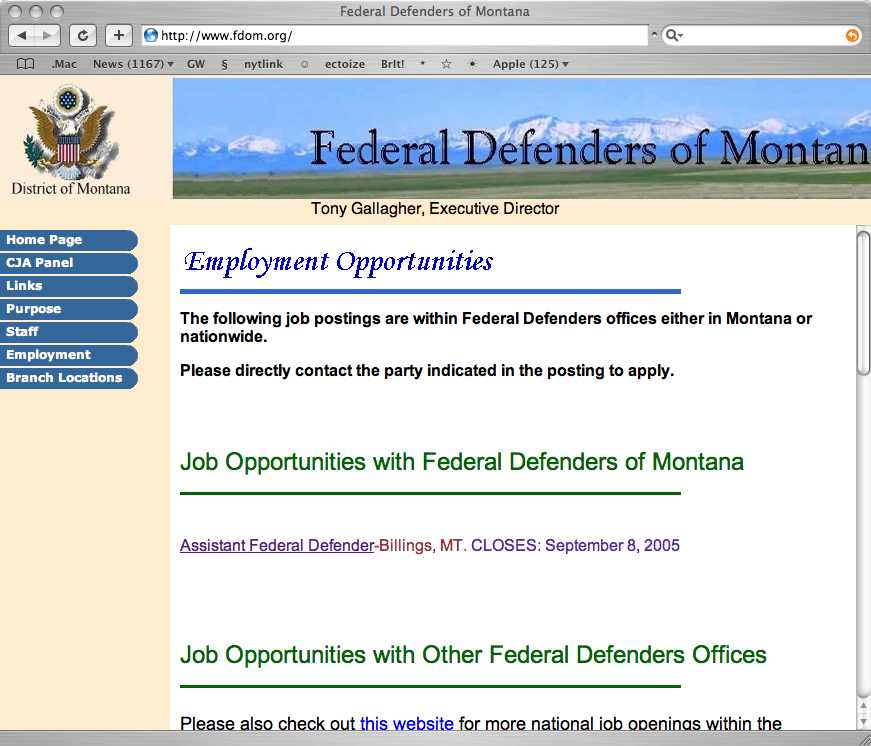 Check out this job opening to become an Assistant Federal Defender for the Federal Defenders of Montana. It sounds like a dream job to me! However, if they're advertising now, they want someone before this time next year, right? And an even bigger problem: Federal defenders don't hire people fresh out of law school, do they?
Help! Does anyone have thoughts on these questions?
More generally, I have to put together a public defender job search and I really don't know where to begin. Any thoughts on methods and strategies would be greatly appreciated.
Damn. There's probably nothing that scares a third-year law student more than not having a job! But hey, I don't graduate for nine more months—why would I be nervous about having no job at this point? Well, for those not familiar w/it, let me explain the “usual” path to your first law job: First, you work in a firm during your second summer (between your second and third years of law school), you do well there, and at the end of the summer you get an offer of employment beginning the following year after you've graduated and taken the bar exam.* If I had followed this path, I'd probably have a job offer right now. I started clinic orientation yesterday and spoke w/several of my peers who are in such a position—happy, carefree, with job offers securely in hand. They're looking forward to a final year of law school w/out a care in the world. Only if they failed some classes (nearly impossible to do) would they need to worry about getting a job after they graduate. As for me? As John Stewart is fond of saying, I got nuthin.
*By the way, this is directly related to whether the third year of law school is really worthwhile or necessary. The system basically works like this: Law school gives you some basics and puts you into massive debt. The system assumes (mostly correctly) you will go to work for a firm to pay off that debt, and firms assume (correctly) that you will know next to nothing about the actual practice of the law when you finish law school so they build in a several-year apprenticeship where they make new associates do all kinds of menial and mindnumbing crap as they learn how to actually become lawyers. But since these firm job offers come before the third year even begins, that final year looks an awful lot like just a mechanism to give law schools a lot more money and put law students a lot deeper into debt. That debt helps to perpetuate the system b/c it ensures that new graduates are indebted enough to put up w/the awful workloads and power games of the firms. Cool.
Posted 06:27 AM | Comments (5) | TrackBack
Questioning 3L
You may have missed it, but last week the American Bar Association held its annual meeting in Chicago. Who knew? My Shingle noticed, but only to say that the conference didn't offer much for most lawyers. Maybe that's why most of us knew little about it.
But on the heels of that conference the AP ran a story asking: Is the third year of law school really necessary?
But if it's an extended vacation, it's pricey: $30,000 or more at top private schools. And at many law schools, grads can't count on the six-figure salaries awaiting many at the most prestigious programs, so an extra year of debt is a big burden.
The two stories (the ABA Conference and the story about 3L) are linked because apparently the ABA recently updated its accreditation guidelines for law schools “to require more total minutes of instruction, but offering schools more flexibility in how that's structured.” Everyone seems to agree that the third year of law school is currently not very valuable for most students, but they disagree on whether that means it should be made more rigorous or disposed of altogether. As Evan Schaeffer noted, Professor Ann Althouse is firmly in the “make it more rigorous” camp:
Hm. Really? Because lawyers are like, um, brain surgeons or something? The good professor is certainly onto something in terms of most newly-minted lawyers being woefully unprepared to actually practice law, but that's certainly not for lack of time spent in law school! In a comment to the professor's post, “Kevin S.” sums up what I would say are the real issues here:
I would say the answer to those questions is “no,” “very little,” and “no.” Judging from this essay from Evan Schaeffer—a practicing attorney who's been there—I'm not the only one. There are clearly lots of people who are very invested in making the law seem more complex and difficult than it really is, and these are often the same people who tend to infantilize the public and speak in patronizing tones about how we must protect people from poorly trained lawyers and that the best way to do that is to regulate legal education—hence, the ABA's ridiculous accreditation requirements. For a small taste of just how ridiculous those requirements are, Dennis Kennedy writes:
Kennedy goes on to speculate about “whether law school has become impossibly over-academized.” Good question. Perhaps something of an answer can be found in the fact that too many law professors have close to zero experience actually practicing law. That being the case, it's no wonder we get constantly tested on “issue-spotting” and graduate w/out knowing how to file a motion in court. Our good professors are only teaching us what they know and, damn!, can they ever spot those issues!
But the ABA's accreditation requirements are a special peeve of mine because they are probably the single biggest impediment to getting rid of the third year, and of course, law schools will fight tooth and nail to make sure the ABA continues to require the third year because it means so much extra cash for law schools. This creates a self-reinforcing cycle there that's good for no one but the law schools, as far as I can see. The accreditation requirements' emphasis on number of books in the library or number of computer labs or whatever also tends to drive up costs for students who will then go out into the “real” world and often have to deal with older or nonexistent technology and sharply curtailed access to legal materials—a situation for which law school has not prepared them at all. Again, all of this is good for ... whom?
I'll be starting my 3rd year of law school in a couple of weeks and perhaps I will find that it's very valuable. Perhaps not. L-Cubed says he'd rather have his $40k back and I bet I will, too. What is certain is that the insanely high cost of a legal education does not serve the public good. Also certain is the fact that the current system of legal education assumes that newly-minted JD's will learn most of what they need to know for their daily work on the job, which means we pay absolutely astonishing amounts of money to get a credential so that we can then go on to a job where we can learn how to use our credential. Does this really make sense? Is this really the best way to ensure our country's legal system is fair and accessible to all citizens?
Candide, where are you?
Posted 09:40 AM | Comments (9) | TrackBack
Locker Cleanout
I had to clean out my locker at school yesterday so that it will be available to assign to someone else in the coming weeks. It was the first time I'd been up there in months—probably since school ended in early May—so it felt a little strange to be back in the narrow and slightly dark halls of the 3rd floor. It was eerily quiet, as if I was the only one in the whole building, and I was surprised to feel something like, oh, I don't know, could it be fondness for the place? Suddenly it seemed impossible that I'd already spent so much of two years of my life in that place, and that my last year there was about to begin and would be over so soon and that I might never see the place again. As soon as I felt that I immediately checked the emotion. “You will have no reason to miss this place!” I scolded myself. But of course I will. That's the way these things work.
With that in mind, and with the semester really only a couple of weeks away (if you count the two weeks of “orientations” I'll be involved in w/clinic and journal), I'm going to try not to wish my last year away. It's easy in law school to always be thinking ahead to the next goal—finals, the summer job, graduation, passing the bar, whatever it is—and you end up not really being there fully for whatever it is you're going through at the time. I certainly did that last fall, maybe a little less so in the spring. But with only two semesters left, I think I'll slow things down a bit, try to smell the roses, so to speak. That's the plan anyway.
Maybe I should start now by enjoying what's left of summer, huh?
Posted 07:12 AM | Comments (1) | TrackBack